
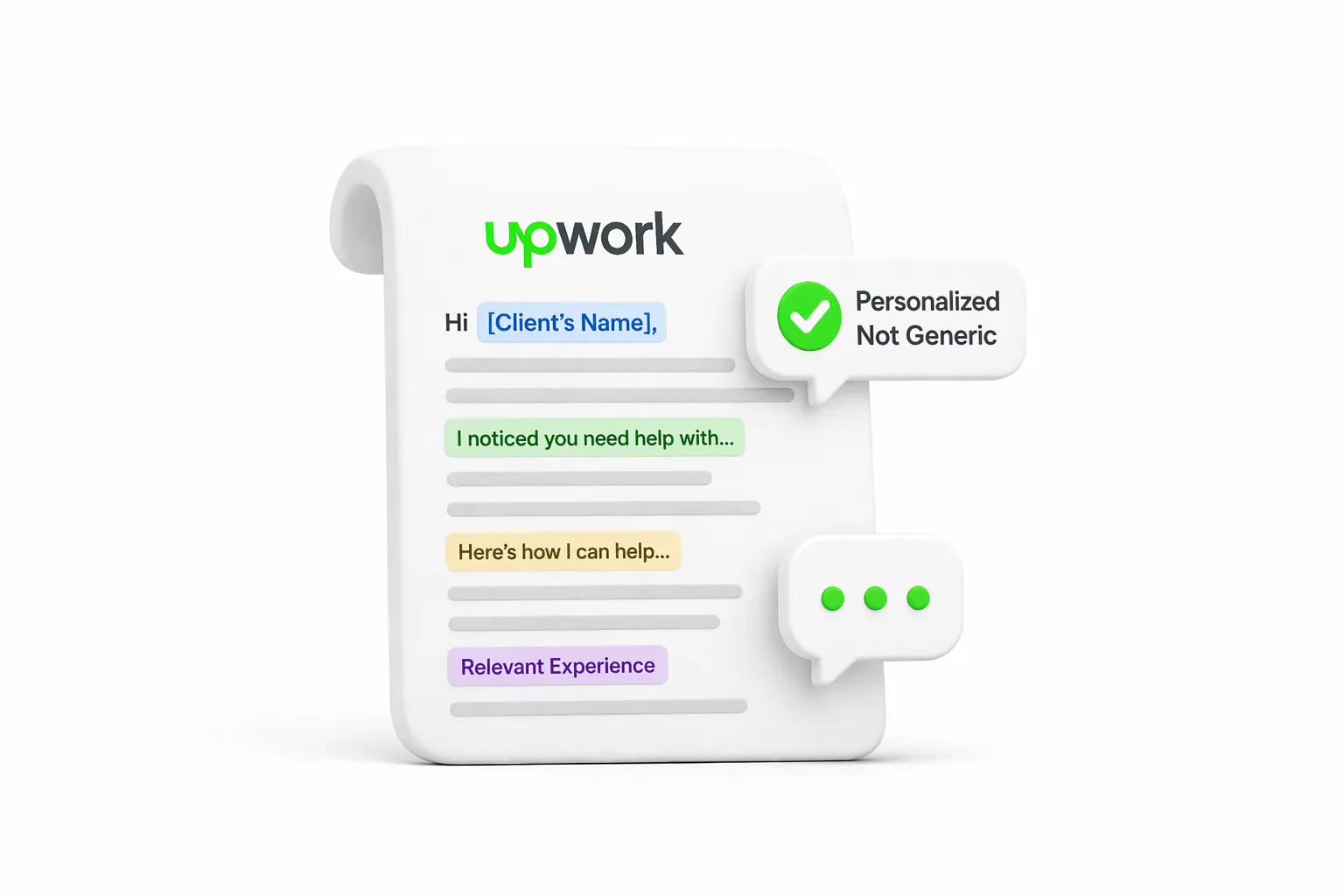
How to Personalize an Upwork Cover Letter for Better Reply Rates Without Sounding Fake
Most Upwork cover letters fail before the client even reaches line three. Not because the freelancer is bad. Not because the skill is missing. Because the proposal reads like it was sent to twenty other jobs that same morning. That costs you replies, burns Connects, and quietly trains you into a bad habit: applying more instead of applying better.
The fix is not writing a longer proposal. It is not trying to sound more impressive either. The real shift is simpler than that. You need to make the client feel that your proposal belongs to this job, this problem, and this moment.
This article will show you how to personalize an Upwork cover letter for better reply rates in a way that is fast, practical, and sustainable. You will see what clients actually notice, what fake personalization looks like, how to build a repeatable workflow, and where GigUp fits when you want speed without losing relevance.
#The Real Problem With Most Upwork Cover Letters
A lot of freelancers think personalization means dropping the client’s name into the first sentence and changing two words in a template.
That is not personalization. That is decoration.
Clients can feel the difference immediately. They open a job post because they have a specific problem. Then they get ten proposals that talk mostly about the freelancer. Years of experience. Generic skills. Big promises. Soft phrases. Almost nothing that proves the freelancer actually understood the work.
So the client does what most buyers do when inboxes get crowded: they skim, filter, and ignore.
#What bad personalization usually looks like
Here is the common pattern:
- A generic opener like “I am excited to apply for your job”
- A paragraph listing broad experience
- A copied block of services
- A weak ending like “Looking forward to hearing from you”
It sounds safe. It also sounds forgettable.
Now compare that with a better approach.
A strong proposal quickly signals three things:
- I understand what you are trying to do
- I see the risk or friction in this project
- I can explain why I am a fit in a way that feels specific
That is what improves reply rates.
#Why This Matters More Than Most Freelancers Think
Late applications, weak-fit jobs, and low-quality personalization create a compounding problem.
You spend time finding jobs. You spend Connects applying. You wait. Nothing happens. Then you assume the answer is more volume.
That is where a lot of freelancers get trapped.
The hidden cost is not just the lost Connects. It is the lost focus. When your proposal process is weak, your job search becomes noisy. You start applying too broadly. You stop protecting your time. Your win rate drops, and suddenly Upwork feels random when it is actually your workflow that is leaking.
Personalization fixes more than messaging. It improves filtering.
When you force yourself to personalize an Upwork cover letter for better reply rates, you naturally ask sharper questions:
- Is this job actually a fit?
- Do I have proof for this type of work?
- Can I explain the client’s problem clearly?
- Is this worth spending Connects on?
That is why better proposals and better job selection usually rise together.
A helpful bridge here is understanding proposal efficiency as a system, not a writing trick. That is exactly why articles like how to protect your Connects and apply more selectively matter. Better reply rates usually start before the writing starts.
#What Clients Actually Mean by “Personalized”
Let’s simplify it.
A personalized proposal is not one that says more. It is one that reduces uncertainty faster.
The client is thinking:
- Does this person get the job?
- Do they sound real?
- Can they solve my problem without creating new ones?
So personalization should aim at those questions.
#A simple mental model
Think of your proposal like a short diagnostic note, not a mini autobiography.
A bad cover letter says, “Here is everything about me.”
A better cover letter says, “Here is what I noticed about your situation, here is why it matters, and here is why I am a sensible next step.”
That shift changes the whole tone.
#The 4 things clients notice fast
| What the client notices | What weak proposals do | What better proposals do |
|---|---|---|
| Job understanding | Repeat the post back vaguely | Name the actual goal, bottleneck, or risk |
| Relevance | List broad skills | Connect 1-2 specific skills to the job |
| Credibility | Make claims | Use proof, examples, or similar project logic |
| Ease | Sound needy or heavy | Make the next step feel simple and low-friction |
This is where many freelancers overcomplicate things. You do not need to personalize every sentence. You need to personalize the parts that influence trust.
#How to Personalize an Upwork Cover Letter for Better Reply Rates
Let’s get tactical.
#1. Personalize the opening around the job, not around yourself
The opening should prove attention.
Not fake enthusiasm. Not a biography.
Weak:
I am excited to submit my proposal for your project.
Better:
You do not just need a React developer here. You need someone who can clean up a slow dashboard flow without breaking the parts your users already rely on.
Why this works: it frames the job in the client’s terms. It sounds like you entered the project, not just the bidding queue.
#2. Pull out the specific decision the client is trying to make
Most clients are not simply hiring a “designer” or “developer.” They are making a smaller decision inside that label.
Maybe they are asking:
- Can this person improve conversion without redesigning everything?
- Can they ship fast without becoming a management headache?
- Can they handle ambiguity?
- Can they work safely with weak documentation?
Your proposal should speak to that.
Imagine two freelancers apply to a job for landing page optimization.
Freelancer A says, “I have five years of experience in design and CRO.”
Freelancer B says, “This looks less like a full redesign problem and more like a clarity and friction problem on your hero, CTA flow, and mobile sections.”
Freelancer B sounds closer to the problem. That usually wins attention.
#3. Use proof that matches the client’s risk
Generic proof is weak proof.
Saying “I have worked with many clients” does not help much. Proof should match what the client is worried about.
If the client fears technical mistakes, show technical credibility. If the client fears delays, show execution discipline. If the client fears poor communication, show structured collaboration.
Try this format:
- Similar project type
- Similar outcome
- Similar constraint
Example:
I recently helped a SaaS team rewrite onboarding emails and key landing page sections where the real issue was not copy length but message clarity. The result was a cleaner funnel and faster approval because the copy was tied directly to the user journey.
That feels grounded. It also avoids sounding inflated.
#4. Mirror the client’s context, not their exact words
This is important.
A lot of freelancers think personalization means repeating the job post back. That often feels robotic.
Instead, translate the job into plain language.
If the client says: “Need a full-stack developer to improve API performance and stabilize user dashboard issues.”
You can say:
It sounds like the bigger issue is not just speed in isolation. It is reliability in the places users touch most, especially if dashboard lag is making the product feel less trustworthy.
That shows understanding without parroting.
#5. Give a small opinion
Strong proposals often include one calm, useful opinion.
Not a lecture. Not free consulting. Just a sign that you can think.
For example:
- “I would probably start by fixing the highest-visibility friction before touching lower-impact issues.”
- “For this kind of project, fast communication matters almost as much as the code itself.”
- “If your goal is better reply rates, the first two lines of the cover letter matter more than adding more credentials lower down.”
A small opinion makes you sound real. Generic proposals usually avoid opinions because they are designed to fit every job. That is exactly why they underperform.
#6. End with a low-friction next step
Do not finish with a vague “please let me know.”
Give the client an easy path forward.
Examples:
- “If helpful, I can outline how I would approach this in three steps before you hire.”
- “Happy to send a short sample structure for the first deliverable so you can judge fit quickly.”
- “If you want, I can show how I would prioritize the first fixes based on the goals you mentioned.”
This works because it lowers the decision weight.
#What Fake Personalization Looks Like
You should avoid anything that feels like theater.
#Common mistakes
- Using the client’s name too much
- Overpraising the project
- Repeating job post lines without adding interpretation
- Stuffing the proposal with buzzwords
- Claiming deep understanding without evidence
- Sending “custom” proposals that are clearly lightly edited templates
Clients are not grading creativity here. They are grading signal quality.
The proposal only needs to answer one emotional question: “Does this person seem like they actually get it?”
#A Better Workflow: Personalize Faster Without Losing Quality
This is the part most advice skips.
Yes, personalization matters. But if it takes you 35 minutes per proposal, your workflow breaks. You either slow down too much or fall back into generic copy.
So the goal is not maximum customization. It is efficient relevance.
#Use this 5-part personalization checklist
Before you send any proposal, check these five things:
| Check | What to ask | Why it matters |
|---|---|---|
| Fit | Is this job truly aligned with my skills and proof? | Better fit makes personalization easier and more believable |
| Problem | What is the actual pain behind the post? | Clients reply to understanding, not generic interest |
| Proof | What one example best reduces doubt here? | Relevant proof beats long experience lists |
| Angle | What specific point can I say that others probably will not? | This makes the proposal feel human and tailored |
| Next step | What is the easiest reply for the client to send? | Lower-friction endings increase response odds |
Save that checklist. It is more useful than most proposal templates.
#The before-and-after difference
Before: You search manually, open too many jobs, skim half of them, then try to force the same cover letter onto weak-fit posts.
After: You filter harder, focus on better-fit jobs, identify the client’s real concern, pull the right proof, and send fewer but sharper proposals.
That is how reply rates improve.
#Where GigUp Fits in This Process
This is where automation helps, but only if it supports judgment instead of replacing it.
GigUp is useful because the real bottleneck is not just writing. It is everything before the writing: finding strong-fit jobs early, filtering noise, keeping your process consistent, and generating a strong first draft that still feels relevant.
#Better job selection leads to better personalization
If you are applying to random jobs, personalization becomes hard work.
If you are seeing jobs already matched against your profile, the writing gets easier because the fit is clearer from the start.
GigUp helps by:
- Monitoring your saved Upwork searches automatically
- Scoring jobs against your profile
- Showing which jobs are Excellent, Good, Fair, or Poor matches
- Helping you focus proposal energy where it has the highest chance of paying back
That matters because a personalized cover letter written for the wrong job is still a weak use of time.
If you are trying to sharpen the full pipeline, not just the writing, this is also why broader workflow pieces like building a smarter Upwork automation system and understanding how search timing affects visibility matter so much.
#Proposal drafting becomes more practical
Once you choose the right job, GigUp can generate a tailored draft using your profile, skills, and project history. The point is not to paste blindly. The point is to start from a draft that already understands the job, then tighten the message around the client’s real concern.
That is a better use of AI.
Bad AI use creates generic volume. Better AI use creates faster relevance.
That difference matters, especially now that freelancers are more cautious about low-quality proposal automation. If that topic is on your radar, this guide on AI proposals and platform risk is a useful companion read.
#A Practical Process You Can Use Today
Here is a clean workflow for anyone trying to personalize an Upwork cover letter for better reply rates without wasting half the day.
#Step 1: Filter harder before writing
Do not personalize every job. Personalize the right jobs.
Ask:
- Is the client clear enough?
- Is the budget realistic?
- Is the work type aligned with my proof?
- Is there enough signal in the post to write something specific?
If not, skip it.
#Step 2: Extract the job’s core tension
Write one sentence privately before you draft.
Use this formula:
This client needs help with [goal], but the real risk is [friction].
Example: “This client needs help redesigning a SaaS landing page, but the real risk is improving clarity without hurting existing conversion flow.”
That single sentence will improve your proposal quality immediately.
#Step 3: Choose one proof point
Not three. One.
Pick the most relevant example, skill cluster, or project type that matches the client’s situation.
#Step 4: Write a sharp opening
Open with the job, the bottleneck, or the key decision.
Avoid empty greetings and generic excitement.
#Step 5: Add one useful opinion or framing line
This is where your thinking shows.
#Step 6: End with an easy next step
Do not make the client work to respond.
#Example Structure You Can Adapt
Here is a simple structure that works well:
#Opening
Show that you understand the job and its real difficulty.
#Relevance
Connect your background to this exact kind of work.
#Proof
Use one example that reduces doubt.
#Opinion
Add one practical insight or approach note.
#Close
Offer a low-friction next step.
You do not need a masterpiece. You need a proposal that sounds like it belongs in that job thread.
#What to Do if You Are Short on Time
This is where most freelancers get honest: “I know personalization matters, but I cannot spend forever on every cover letter.”
Fair.
So simplify.
When time is tight, personalize these three parts first:
- The first two lines
- The most relevant proof line
- The closing next step
If those three parts are strong, the whole proposal usually feels more personal even if the middle stays lean.
That is a good tradeoff.
#FAQ
#How long should a personalized Upwork cover letter be?
Usually shorter than you think. Long enough to prove understanding and fit. Short enough to respect the client’s attention. In many cases, 120 to 250 words is enough.
#Should I use templates at all?
Yes, but use them like structure, not like final copy. A template should speed up thinking, not replace it.
#Does mentioning the client’s exact job post help?
Only if you add interpretation. Repeating their words without insight usually feels fake.
#Can AI help personalize proposals?
Yes, if it starts from your real profile and a real job, then gives you a draft to refine. No, if it produces generic copy at scale with little job-specific reasoning.
#What improves reply rates more: better writing or better job targeting?
Usually better targeting first, then better writing. Strong personalization is much easier when the job is already a solid fit.
#Final Take
If your Upwork proposals are not getting replies, the answer is usually not “write more.” It is “make the proposal feel closer to the client’s actual problem.”
That is the real job.
Personalize an Upwork cover letter for better reply rates by making it specific where it counts: the opening, the problem framing, the proof, and the next step. Keep it human. Keep it sharp. Keep it useful.
And if your bigger issue is that you are still finding jobs too late, sorting through weak-fit listings, or spending too much time rebuilding the same proposal logic over and over, GigUp is the practical next move. It helps you find stronger-fit jobs faster, filter them intelligently, and generate proposals that start closer to relevance instead of starting from zero.