
In 2024, you could "hack" the Upwork system. If you wanted to rank for "Shopify Developer," you simply pasted that phrase 15 times into your profile overview, bid on 100 jobs a day, and waited for the algorithm to reward your brute force.
In 2026, that strategy is not just dead—it is actively penalized.
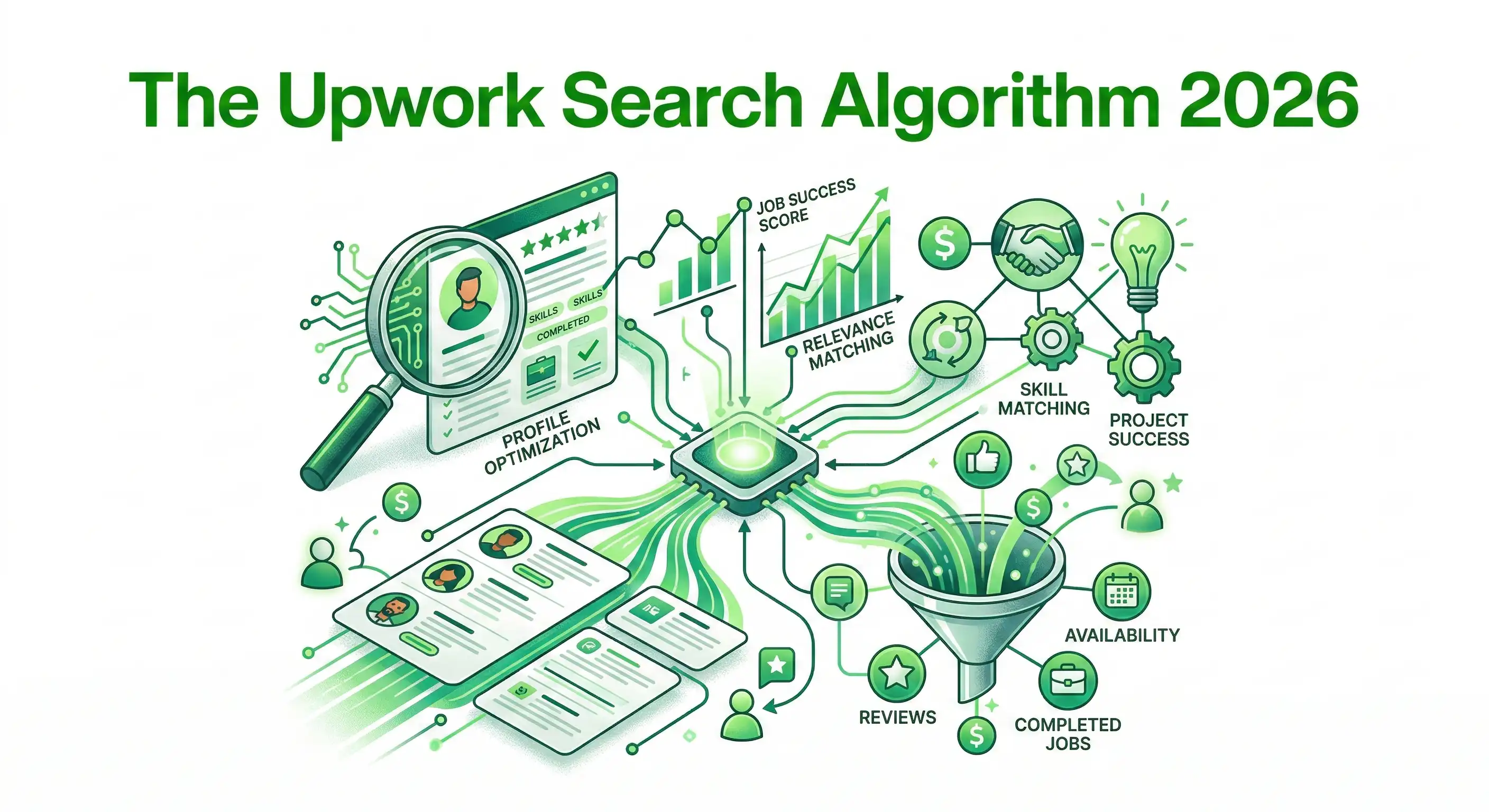
Upwork has officially transitioned from a rudimentary "Keyword Search" engine to a Predictive Compatibility Engine. Powered by proprietary LLMs (Large Language Models) and Upwork’s internal AI architecture, the platform no longer cares about who can do the job. It is obsessed with predicting who is most likely to get hired, complete the job without disputes, and deliver a 5-star result.
At GigUp, we don’t rely on guessing. Our AI matching engine has processed over 730,200+ job postings. We have tracked the exact moment jobs are posted, analyzed which freelancers win the contracts, and reverse-engineered the patterns of profiles that consistently secure the coveted "Best Match" badge.
If your profile views have flatlined, you aren't shadowbanned. You are simply misaligned with the new machine-learning filters. Here is the ultimate, data-backed guide to the 7 core ranking factors for the 2026 Upwork algorithm—and exactly how to engineer your profile to dominate them.
#The Core Philosophy: Why Upwork Changed the Game
Before we optimize, you need to understand the battlefield. Upwork's primary metric for success as a publicly traded company is Client Retention.
When a client searches for a "React Native Developer," they do not want to see 10,000 results. They experience "Decision Fatigue." Upwork realized that if a client has to interview 15 people to find a good fit, they will leave the platform and use an agency next time.
The 2026 algorithm was designed to act as a ruthless executive assistant. Its job is to hide the bottom 90% of freelancers and only present the top 10% who have mathematically proven they can close contracts quickly and efficiently.
This gap between appearing in a broad search and actually being selected by the AI as a "Best Match" is where most freelance careers bleed out. To cross that gap, you must master these 7 factors.
#Factor 1: Niche Density & The SEO Blueprint
The single biggest reason freelancers fail to rank in 2026 is Profile Dilution. Upwork’s internal data, heavily supported by our 730k+ job analysis, shows that specialization is now the primary gating mechanism for organic visibility.
#The "Generalist" Penalty
Upwork’s AI assigns a "Relevance Score" to your profile. If your headline reads "Graphic Design | Data Entry | JavaScript," the AI views you as a high-risk, low-expertise hire. It cannot confidently place you in a "Best Match" bucket because your semantic signals are completely scattered.
#The 2026 SEO Blueprint for Maximum Density
To force the algorithm to recognize you as an authority, you must deploy Niche Density. Every element of your profile must point to one specific, highly lucrative sub-niche.
1. The "First 160" Rule (Your Meta Description) The Upwork search results page only shows the first roughly 160 characters of your profile overview. More importantly, the AI gives disproportionate weight to these first two sentences. If your core keyword is not in the first 160 characters, you are invisible.
- Bad Example (The Rambler): "Hi there! My name is Alex and I have been passionate about coding since I was 12 years old. I love helping clients achieve their dreams..." (Result: Zero keyword density, zero ranking).
- Good Example (The Sniper): "Senior React Native Developer specializing in FinTech mobile apps. I help established financial startups build secure, high-performance iOS/Android dashboards." (Result: High density for React, FinTech, Mobile, iOS, Android).
2. Keyword Proximity in Titles Don't just use keywords; place them strategically. The algorithm reads left to right.
- Weak: "Experienced Developer for Web, Apps, and React."
- Strong: "React Native Developer | FinTech Mobile Architecture."
3. Skill Tag Clustering You are allowed 15 skill tags. Do not use them to cast a wide net. Use them to build a Semantic Cluster. If you are an SEO copywriter, do not tag "Data Entry" just because you can do it. Your tags should be: SEO Writing, B2B Copywriting, Content Strategy, Keyword Research, Conversion Rate Optimization, Blog Writing. This tells the AI: "This person is a master of one domain."
#Factor 2: Response Velocity (The 15-Minute Window)
You can have the most perfectly optimized profile in the world, but if you are slow, you are dead. Our analysis reveals a massive correlation between Response Velocity and long-term search visibility.
Upwork tracks your "Median Response Time" as a core metric of platform health. The algorithm wants to serve clients freelancers who are active and eager.
#The Data Behind the Speed
According to our tracking of over 60,000+ job alerts sent through GigUp, the reality of the platform is brutal: Premium jobs are often "decided" within the first 15 to 30 minutes of being posted.
- The Velocity Boost: Freelancers who consistently respond to direct invitations or apply to fresh, highly relevant jobs within the first 60 minutes receive a hidden "Availability Multiplier" on their profile.
- The Speed Penalty: If you regularly take 24 to 48 hours to reply to client messages or invites, the algorithm quietly throttles your search ranking. Why show you to a VIP client if you take two days to reply?
#The Automation Advantage
It is physically impossible to achieve elite Response Velocity manually. If you are sleeping, eating, or actually doing client work, you are missing jobs.
This is where workflow automation becomes mandatory. Tools like GigUp monitor the Upwork API 24/7. When a job matching your exact criteria is posted, it pushes an instant alert to your Telegram or Slack. You go from finding a job 4 hours late to applying in 4 minutes. Speed is the ultimate SEO hack.
#Factor 3: The "Invite-to-Hire" Ratio
Most freelancers believe that getting invitations is the ultimate goal. It is not. Hiring is the goal.
If Upwork sends you 10 search-based invitations and you only land 1 contract, the algorithm interprets this as a failure. You become a "poor closer" in the eyes of the machine.
#The Math of Matchmaking
Every time a client sends an invite that doesn't lead to a hire, it represents friction on the platform. If you accept invites that you are wildly unqualified for—or if your pricing is completely misaligned with your skill level—you will not win the job, and your "Invite-to-Hire" ratio drops.
The Actionable Fixes:
- Only Accept High-Probability Invites: Stop accepting every invite out of desperation. If an invite is a bad fit, decline it immediately using the "Not a fit for my skills" reason.
- Declining is SEO-Positive: Declining an invite quickly is actually better for your algorithmic health than accepting an invite, wasting the client's time, and not getting hired. It trains the AI on what you don't want, refining your future "Best Match" placements.
- The 60%+ Rule: At GigUp, our AI analyzes every job and gives you a Match Score. We strictly advise our users: only spend Connects or accept invites on jobs where you have a 60% or higher algorithmic match.
#Factor 4: Semantic Portfolio Matching
In the past, your portfolio was just a gallery for human eyes. In 2026, Upwork’s search engine uses Computer Vision and Natural Language Processing (NLP) to "read" your portfolio items.
If you upload a generic image called work-sample-1.png with a two-sentence description, you are wasting prime SEO real estate.
#Optimizing for the AI "Crawler"
When a client searches for "D2C Shopify Redesign," the algorithm doesn't just scan your profile text; it scans your portfolio metadata. It prioritizes profiles whose portfolio descriptions contain exact semantic matches to the client's search query.
The Perfect 2026 Portfolio Template: To dominate Semantic Portfolio Matching, structure every portfolio piece like a mini SEO blog post:
- Project Title (H1): [Action] + [Niche] + [Tech Stack] (e.g., "Increased Conversion by 40% for D2C Skincare Brand via Shopify Liquid Redesign")
- The Problem: Briefly explain what the client was struggling with. (e.g., "The client had a high cart abandonment rate due to a clunky mobile checkout.")
- The Solution: Explain what you did, injecting your LSI (Latent Semantic Indexing) keywords. (e.g., "I developed a headless commerce solution using React and Shopify Storefront API...")
- The Impact: Use hard numbers. (e.g., "Resulted in a 40% increase in mobile conversions and $50k MMR growth.")
- Skills & Deliverables Tags: Ensure these perfectly mirror the 15 skill tags on your main profile.
#Factor 5: The JSS & Private Feedback Masterclass
Your public Job Success Score (JSS) is a vanity metric. Let me repeat that: A 100% public JSS does not guarantee you will rank.
The true, hidden ranking factor is the Private Feedback clients leave when they close a contract.
#Decoding the Private Metric
When a client ends a contract, Upwork prompts them with a private survey that freelancers never see. The most critical question on this survey is:
"On a scale of 0 to 10, how likely are you to recommend this freelancer to a colleague?"
Upwork uses the Net Promoter Score (NPS) framework:
- Scores 9-10 (Promoters): Massive boost to your JSS and search rank.
- Scores 7-8 (Passives): The algorithm views this as a "Neutral" experience. It will actively lower your ranking over time, even if the client left you a public 5-star review!
- Scores 0-6 (Detractors): Immediate drop in JSS and search visibility.
The "Invisible Shadowban" Trap: If your JSS is 100% but your profile views have plummeted to zero, you are caught in the "Passive Trap." You have clients giving you public 5-star reviews (to be polite), but privately giving you 7s and 8s because you missed deadlines or communicated poorly.
#The "10/10" Extraction Script
You cannot control what a client clicks in private, but you can heavily influence it through off-boarding psychology. When a project is 100% complete and the client is happy, send this exact script before the contract is closed:
"Hi [Client Name], I'm thrilled we could hit the launch goal for the [Project Name]! Working with you has been fantastic. Before we close the contract, my personal standard is a 10/10 experience for my clients. If there is absolutely anything that would prevent you from recommending my services to a colleague as a 10/10, please let me know right now so I can fix it on my own time. > If everything is perfect, feel free to close the contract! Thank you again."
This script does two things: It explicitly primes their brain with the number "10", and it anchors the concept of "recommending to a colleague" right before Upwork asks them that exact question in private.
#Factor 6 & 7: Availability Recency and Identity Trust
These two factors are the "Gatekeepers." They won't necessarily push you to #1 on their own, but failing to maintain them will permanently lock you out of Page 1.
#Factor 6: Availability Recency
The "Available Now" badge costs Connects, but its true value isn't just the visual badge—it’s the algorithmic signal of Recency.
The 2026 algorithm heavily prioritizes freelancers who actively log in, update their availability, and interact with the platform daily. Upwork’s worst nightmare is a client messaging a "Ghost Profile" that hasn't logged in for three weeks.
- The Hack: Even if you don't buy the "Available Now" badge, log into the mobile app at least once a day. Refresh your feed. This pings the server with a "Last Online: Today" timestamp, giving you a baseline Recency Boost.
#Factor 7: Identity Trust Scores
With the massive influx of AI-generated profiles and offshore arbitrage agencies, Upwork has weaponized Trust Signals.
- Identity Verification: Mandatory. Do not delay your video verification.
- Skill Certifications: Upwork now partners with companies (like HubSpot, Google, and Adobe) to verify skills. Profiles with "Partner-Verified" certifications see an average 25% lift in search impressions.
- The Badge Floor: Badges like "Top Rated" and "Expert-Vetted" act as a "Rank Floor." They ensure that temporary dips in your analytics won't drop you to Page 10. They act as a buffer against algorithmic volatility.
#The Connects Economy: Algorithm vs. "Pay-to-Play"
In 2026, freelancers are burning thousands of Connects "boosting" their proposals and profiles. Does paying for the top spot actually improve your organic SEO over time?
The short answer is: No.
#The Connects Burn Rate
Boosting your profile (paying Connects per click) is a temporary sugar rush. If your profile lacks Niche Density (Factor 1) and your Semantic Portfolio (Factor 4) is weak, clients will click your boosted profile and immediately bounce.
Upwork’s algorithm tracks this "Bounce Rate." If you pay for 50 clicks and secure 0 interviews, the AI assumes your profile is highly irrelevant to your chosen keywords. When your boosting budget runs out, your organic rank will actually be lower than when you started.
The Elite Strategy: Optimize your organic ranking factors first. Achieve a baseline of organic invites. Only use profile boosting to pour gasoline on a fire that is already burning.
#Agency vs. Solo Freelancer Dynamics
A massive shift in 2026 is how the algorithm treats Agencies versus Independent Freelancers.
- The Agency Penalty: Upwork's data showed clients increasingly prefer working directly with the talent rather than going through an agency middleman. Consequently, the algorithm gives a slight organic boost to "Independent" profiles in generic search results.
- The Agency JSS Shield: However, if you are part of a highly-rated agency, your individual profile benefits from the "Agency JSS Shield." If an agency has a 100% JSS, it acts as a massive Trust Signal (Factor 7) for all freelancers under its umbrella, often bypassing the "Independent" boost for high-ticket Enterprise clients.
If you are a solo freelancer, lean heavily into your personal brand and direct communication in your overview to capitalize on the algorithm's preference for direct-to-talent matches.
#Step-by-Step: The 30-Day "De-Ranked" Recovery Plan
If your profile is completely dead, reading this article won't save you. Action will. If you have noticed a sudden drop in invitations, your profile has been suppressed. Follow this 30-day algorithmic detox:
#Phase 1: The Algorithmic Audit (Days 1-5)
- Stop Guessing, Start Measuring: You cannot fix what you cannot measure. Upwork localizes search results, meaning what you see when you search yourself is a lie. Use the GigUp Profile Rank Checker. Enter your URL, select your target niche, and let our AI simulate a global client search to find your actual ranking position.
- Close "Zombie" Contracts: Look at your active contracts. If a contract has had zero earnings or communication for 60+ days, it is a "Zombie." It is hurting your JSS and signaling platform inactivity. Message the client, ask them to close it, and request honest feedback.
#Phase 2: Total Optimization (Days 6-15)
- Niche Down Ruthlessly: Rewrite your Title and the first 160 characters of your Overview. Focus on one specific client persona. Delete the word "And" from your title.
- Semantic Overhaul: Update your 3 best portfolio pieces using the "Project Title, Problem, Solution, Impact" framework outlined in Factor 4.
#Phase 3: Velocity & Engagement (Days 16-30)
- Automate Your Velocity: You need to prove to the algorithm that you are alive. Connect your Upwork feed to GigUp’s Smart Trackers. Set up Telegram or Slack alerts for your hyper-niche.
- The "Low-Hanging Fruit" Strategy: Do not apply for $10,000 contracts right now. Apply to 3-5 smaller, quick-turnaround jobs (under $500). Deliver 110% value, use the "10/10 Extraction Script," and generate immediate positive private feedback. This rapid influx of fresh, positive data will force the Predictive Compatibility Engine to recalculate and boost your rank.
#Conclusion: Engineering the Unfair Advantage
The Upwork algorithm is no longer a black box. It is a cold, mathematical, data-driven engine. It rewards Niche Authority, Response Speed, and Client Satisfaction, while ruthlessly punishing generalists and slow responders.
You can spend the next 6 months trying to manually guess what the algorithm wants, burning through thousands of Connects on bad proposals. Or, you can leverage the data.
At GigUp, we have used our database of 730,000+ jobs to build the ultimate asymmetric advantage. We don’t just send you job alerts; we give you a precise AI Match Score that tells you exactly which jobs the algorithm wants you to apply for, saving your Connects and protecting your Invite-to-Hire ratio.
Stop guessing. Start engineering your success.
Get started with GigUp today and join the elite 1% of freelancers who stay at the top of the search results while they sleep.
GigUp — The Intelligent Way to Freelance.