

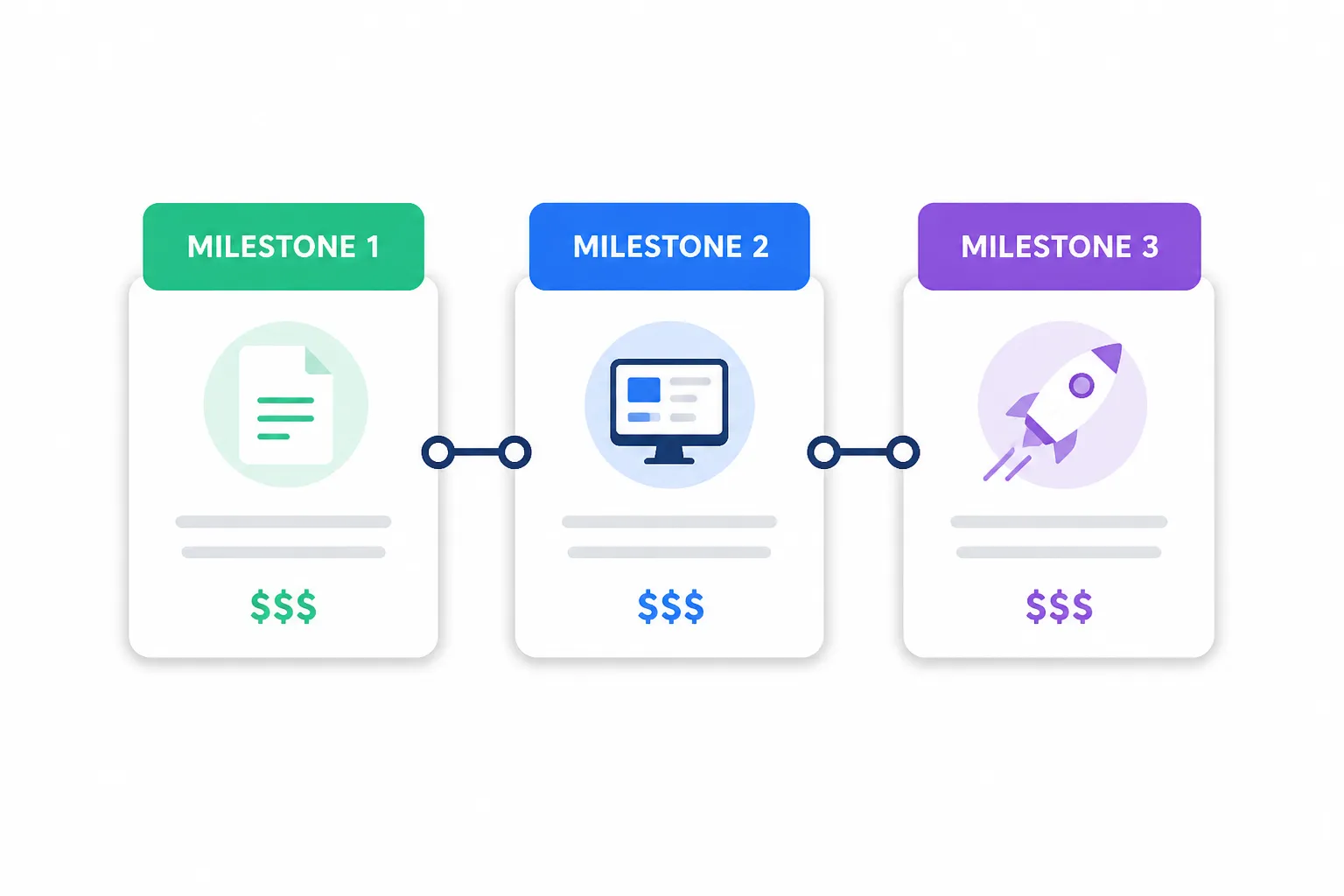
Upwork Fixed Price Milestones: How to Break Projects Into Clear, Paid Stages
Fixed price projects can quietly destroy your profit if the work is not broken into clear stages.
At first, the project looks simple. The client has a budget. You agree on the outcome. Everyone feels good. Then the “small” requests begin. A small layout change. A small extra page. A small integration. A small revision after approval. By the end, the project still has the same price, but the work has doubled.
The better way is to treat every fixed price project as a sequence of paid decisions.
A milestone is not just a payment split. It is a checkpoint where the client reviews a specific piece of work, approves it, and funds the next stage. When milestones are written well, the project feels organized instead of risky. You are not begging to be paid. You are moving the project through a clear process.
This article will help you break Upwork fixed price projects into clean, paid stages so you can reduce scope creep, set better expectations, and protect your time without sounding difficult.
#Why Fixed Price Projects Become Messy So Quickly
Fixed price work is attractive because it feels simple.
The client wants a result. You give a price. The client funds the milestone. You deliver the work.
That is the clean version.
The messy version is what happens when the result is too broad.
For example, a client says:
“I need a website for my business.”
That could mean many different things.
It might include design, development, copywriting, branding, mobile optimization, contact forms, booking tools, hosting setup, SEO basics, speed optimization, and launch support.
If you create one milestone called “Complete website,” you have left too much open.
The client may think everything is included.
You may think only the main build is included.
That difference is where conflict starts.
Fixed price projects do not fail because the client is always bad. They often fail because the work was never turned into clear paid stages before the contract started.
#The Real Purpose of Upwork Milestones
A good milestone does three jobs at once.
It defines what the client gets.
It defines when you get paid.
It defines when one stage ends and the next one begins.
That third part is the most important.
Many freelancers use milestones only as payment chunks. For example:
- Milestone 1: First payment
- Milestone 2: Second payment
- Milestone 3: Final payment
That is better than one giant milestone, but it is still weak.
The client needs to know what each payment is connected to.
A stronger milestone says:
- what will be delivered
- what will be reviewed
- what counts as approval
- what is not included
- what happens after approval
This makes the project feel safer for the client and more controlled for you.
#Think of Milestones as Paid Stages, Not Random Splits
The easiest mental model is this:
A fixed price project should move like a relay race.
You complete one stage, hand it over for review, get approval, and then move to the next stage.
You should not carry the entire project risk until the final delivery.
Bad structure:
“I will build everything, then you review everything, then I hope we agree on what done means.”
Better structure:
“We will confirm the scope, approve the direction, complete the main work, handle defined revisions, and then close the project.”
That second version feels more professional because it gives the client confidence at every step.
It also gives you a natural way to manage changes.
When the client asks for something new, you can say:
“That makes sense, but it belongs in a separate milestone because it is outside the current stage.”
That is much easier than arguing at the end.
#What Each Paid Stage Should Include
Every Upwork milestone should be specific enough that both sides understand what is happening.
Before you accept a fixed price project, check each milestone against these five points.
| Milestone Element | What It Should Explain | Example |
|---|---|---|
| Deliverable | What the client receives | “Homepage desktop and mobile design in Figma” |
| Scope limit | What is included and excluded | “Includes 2 revision rounds, does not include copywriting” |
| Approval point | What the client is approving | “Homepage layout direction will be considered approved” |
| Payment trigger | When the milestone should be released | “After delivery and approval of the Figma design” |
| Next step | What happens after this stage | “After approval, development begins in the next milestone” |
This is not about making your contract complicated.
It is about removing confusion early.
If the milestone cannot explain these points clearly, it is probably too vague.
#A Simple Fixed Price Milestone Structure You Can Use
Most fixed price projects can be broken into four stages.
You can adjust the names based on your service, but the structure works well for websites, apps, design projects, writing projects, marketing projects, and technical work.
| Stage | Milestone | Purpose | Typical Payment Share |
|---|---|---|---|
| 1 | Scope and plan | Confirm requirements before deep work starts | 10-20% |
| 2 | First direction | Show the main concept, draft, layout, or technical plan | 20-30% |
| 3 | Main production | Complete the largest part of the agreed work | 30-50% |
| 4 | Final revisions and handoff | Polish, test, deliver, and close the project | 10-20% |
The exact percentages do not matter as much as the logic.
The first stage protects your planning time.
The second stage prevents you from building too far in the wrong direction.
The third stage pays for the heavy work.
The final stage keeps revisions and handoff controlled.
This structure turns one vague project into a clear path.
#Example: Website Project Broken Into Paid Stages
Imagine a client wants a five-page business website.
A weak milestone structure would be:
| Weak Milestone | Amount |
|---|---|
| Build complete website | $1,000 |
That sounds simple, but it creates risk.
What happens if the client dislikes the homepage direction after you have built all five pages? What happens if they expect you to write the content? What happens if they ask for a booking system after the price is agreed?
A better structure would be:
| Paid Stage | Deliverable | Amount |
|---|---|---|
| Stage 1: Scope and sitemap | Confirm pages, content needs, design references, and website structure | $150 |
| Stage 2: Homepage direction | Create homepage layout/design with up to 2 revision rounds | $250 |
| Stage 3: Full website build | Build 5 approved pages based on confirmed structure and design direction | $450 |
| Stage 4: Testing and handoff | Mobile checks, form testing, basic launch support, and handoff notes | $150 |
This structure is much safer.
The client still sees a clear path to the final website. You still deliver the full result. But now the work is reviewed and paid in stages.
That means fewer surprises.
#Example: SaaS MVP Broken Into Paid Stages
Technical projects need even more care.
A client may say:
“I need an MVP for my SaaS idea.”
That sentence is dangerous if you do not slow it down.
An MVP can include authentication, dashboards, roles, billing, admin tools, email notifications, API integrations, onboarding screens, database logic, analytics, deployment, and bug fixing.
If you accept one milestone called “Build MVP,” you are carrying too much risk.
A better structure:
| Paid Stage | Deliverable |
|---|---|
| Stage 1: Product scope and user flow | Confirm core features, user roles, screens, and what is not included |
| Stage 2: Technical plan and UI structure | Create wireframes, database plan, and architecture direction |
| Stage 3: Core feature development | Build the main agreed user flows |
| Stage 4: Integrations and business logic | Add agreed APIs, payments, emails, or automation |
| Stage 5: Testing, deployment, and walkthrough | Fix scoped issues, deploy, and hand over the project |
The key is simple.
Do not sell “the whole app” as one undefined object.
Sell the project as a set of approved stages.
For software developers especially, this connects directly with job selection. A high-budget job can still be a bad project if the scope is vague, the client is unclear, or the timeline is unrealistic. This is why a smarter filtering process matters before you even send the proposal. You can read more about that in this guide on building a smarter Upwork bidding strategy.
#Bad Milestone Names vs Better Milestone Names
Milestone names matter because they shape expectations.
A vague milestone name invites vague feedback.
A clear milestone name tells the client exactly what they are reviewing.
| Bad Milestone Name | Why It Creates Risk | Better Milestone Name |
|---|---|---|
| Complete website | Too broad | Build 5 approved website pages in WordPress |
| Finish design | No clear deliverable | Create homepage and service page designs in Figma |
| Fix bugs | No limit on bug count | Fix up to 10 listed bugs shared before milestone start |
| SEO setup | Too open-ended | Add titles, meta descriptions, headings, and basic on-page checks for 5 pages |
| Final changes | Can become endless | Complete up to 2 final revision rounds and prepare handoff files |
You do not need fancy language.
You need clear language.
A client should be able to read the milestone and understand exactly what they are paying for.
#How to Decide the Right Number of Milestones
There is no perfect number.
The right number depends on project risk.
For a small project, one or two milestones may be enough. For a medium project, three to five usually works well. For a larger technical project, you may need more.
Use this question:
Where could misunderstanding become expensive?
That is where you need a milestone.
For example, if design direction is risky, create a design approval milestone.
If technical scope is uncertain, create a discovery or planning milestone.
If content depends on the client, make that dependency clear before the build stage.
If launch requires access, tools, or hosting setup, separate it from the main production milestone.
The goal is not to create unnecessary steps.
The goal is to prevent one unclear step from damaging the whole project.
#What to Clarify Before You Start the Contract
Before accepting a fixed price project, you should know what “done” means.
Not generally.
Specifically.
Here is a practical checklist.
#Fixed Price Milestone Checklist
- What is the final deliverable?
- What are the exact parts included?
- What is clearly not included?
- How many revision rounds are included?
- What does the client need to provide?
- When does each milestone count as complete?
- What happens if the client changes direction?
- What happens if extra work is requested?
- Is the timeline realistic?
- Is the payment amount worth the risk?
That last question is important.
Some projects are not badly scoped by accident. They are badly scoped because the budget does not match the expectation.
If the client wants a complex result for a tiny fixed price, clean milestones may not save the deal.
Sometimes the best move is to avoid the project.
#How to Present Milestones Without Scaring the Client
Some freelancers avoid discussing milestones because they think it will make them sound complicated.
It usually does the opposite.
Clear milestones make you sound safer.
Clients do not just hire skill. They hire confidence. They want to believe you can manage the project without chaos.
You can explain your milestone structure like this:
“For fixed price projects, I like to split the work into clear stages. That gives you review points along the way and makes sure we both stay aligned before moving into the next part.”
This sounds calm and professional.
You are not saying:
“I do not trust you.”
You are saying:
“I have a process.”
That difference matters.
#A Simple Proposal Section You Can Use
You do not need to put a full contract inside your proposal.
But you should show that you understand the project and can organize it.
Here is a simple structure:
 1Based on your job post, I would break the project into clear paid stages:
 2
 31. Scope confirmation and project plan
 42. First draft/main direction for review
 53. Main production work based on the approved direction
 64. Final revisions, testing, and handoff
 7
 8This keeps the project clear, gives you review points, and avoids surprises later.
This works because it positions you as a thoughtful freelancer, not just another applicant.
You are not only saying, “I can do the work.”
You are showing how the work should happen.
That is often what makes a client feel comfortable starting the contract.
#How GigUp Helps Before the Milestone Conversation
Milestone structure is important, but it does not fix poor job selection.
If you are applying to weak-fit jobs, vague posts, low-budget clients, or rushed projects, you will keep having difficult milestone conversations.
The better workflow starts earlier.
GigUp helps you monitor Upwork job searches with custom trackers, score jobs against your profile, and focus on opportunities that are more relevant to your skills. Instead of manually scrolling through listings and guessing which projects are worth your Connects, you can use AI matching to spot stronger opportunities faster.
That matters because good milestone conversations are easier when:
- the job fits your skills
- the client has a real budget
- the scope is understandable
- your proposal is relevant
- you are not applying out of desperation
GigUp also helps generate tailored proposals, which makes it easier to introduce a clear staged process from the first message.
Better job filtering leads to better proposals.
Better proposals lead to better expectations.
Better expectations lead to cleaner fixed price projects.
#How to Handle Extra Work After a Milestone Starts
Extra work is not always a problem.
The problem is unpaid extra work.
Clients often ask for additions casually because they do not realize the request changes the scope.
Your response should be helpful, not defensive.
Use this structure:
- Acknowledge the request
- Explain that it is outside the current milestone
- Offer a separate milestone
- Keep the current stage moving
Example:
“Yes, we can add that. It is outside the current milestone, so I suggest we finish this stage first and then create a separate milestone for the booking feature.”
This keeps the relationship positive.
You are not blocking the client.
You are protecting the project.
The client still gets what they want, but the extra work becomes paid work.
#How to Separate Revisions From Scope Creep
Revisions and scope creep are not the same thing.
A revision improves the agreed deliverable.
Scope creep adds a new deliverable.
For example:
Revision:
“Can we adjust the spacing and make the CTA clearer?”
Scope creep:
“Can you also add a new pricing page and connect Stripe?”
One is a refinement.
The other is new work.
Your milestone language should make this clear before the project begins.
For example:
“This milestone includes up to two revision rounds for the agreed homepage design. New sections, new pages, copywriting, branding, or integrations are not included and can be added as separate milestones.”
That sentence may feel strict at first.
But it is actually fair.
It tells the client what is included and gives them a clean path if they want more.
#When One Milestone Is Acceptable
Not every project needs several milestones.
One milestone can work when the project is small, simple, and clearly defined.
For example:
- Write one product description
- Fix one known bug
- Create one simple graphic
- Review one landing page
- Install one plugin
But even then, the milestone should be specific.
Bad:
“Fix issue.”
Better:
“Fix checkout button alignment issue on mobile product page.”
One milestone is risky when the project has many moving parts, unclear requirements, or several approval points.
If the project involves design, development, strategy, integrations, revisions, or launch support, multiple paid stages are usually safer.
#When to Walk Away
Some clients resist milestones because they want flexibility.
That is understandable.
But some resist milestones because they want unlimited work for one fixed price.
You need to know the difference.
Be careful when a client says things like:
- “This should be easy.”
- “Just do everything and I’ll review at the end.”
- “I don’t want to split it up.”
- “We can finalize scope later.”
- “I need unlimited revisions.”
- “The budget is fixed, but requirements may change.”
These are not always deal-breakers, but they are warning signs.
A good client may ask questions about milestones.
A risky client tries to remove boundaries completely.
If the project cannot be clearly staged, it may not be a good fixed price project.
#A Reusable Fixed Price Milestone Template
Use this as a starting point and adjust it for your service.
 1Milestone 1: Scope Confirmation and Project Plan
 2
 3Deliverables:
 4- Confirm final requirements
 5- Review references, files, access, and project goals
 6- Define included pages, features, or tasks
 7- Confirm timeline and next steps
 8
 9Not included:
10- New features or deliverables outside the agreed scope
11- Major direction changes after approval
12
13Milestone 2: First Draft or Main Direction
14
15Deliverables:
16- Create the first version of the main deliverable
17- Share for client review
18- Include up to 2 revision rounds within the agreed scope
19
20Approval note:
21Once approved, this direction will be used for the next stage.
22
23Milestone 3: Main Production Work
24
25Deliverables:
26- Complete the agreed work based on the approved direction
27- Build, write, design, or implement the confirmed scope
28- Share completed work for review
29
30Not included:
31- Additional pages, features, integrations, or content not listed in the scope
32
33Milestone 4: Final Revisions and Handoff
34
35Deliverables:
36- Complete final revisions within the agreed scope
37- Test or review the completed work
38- Deliver final files, links, access, or documentation
39- Provide a short handoff note if needed
Do not copy templates blindly.
Use them to think clearly.
Your milestone structure should match the actual project, not just follow a generic format.
#FAQ
#What is a milestone on Upwork?
A milestone is a funded stage of a fixed price project. The client funds the milestone, you complete the agreed deliverable, and the client releases payment after review and approval.
#How many milestones should I create for a fixed price project?
Use enough milestones to create clear review and payment points. Small projects may need one or two. Medium projects often need three to five. Complex projects may need more.
#Should I include revisions in every milestone?
Include revisions where they make sense, but limit them clearly. One or two revision rounds are usually enough for most deliverables. Unlimited revisions can turn a fixed price project into unpaid ongoing work.
#What should I do if the client asks for extra work?
Explain that the request is outside the current milestone and offer to create a separate milestone. Keep your tone helpful and practical.
#Is fixed price work better than hourly work?
Fixed price works well when the scope is clear and the deliverables are predictable. Hourly is usually better when the work is open-ended, exploratory, or likely to change often.
#Final Thought
Upwork fixed price milestones are not just payment steps.
They are the structure that keeps the project healthy.
When you break a project into clear, paid stages, the client knows what to expect. You know what you are responsible for. Each stage has a purpose, a deliverable, and an approval point.
That is how you avoid the trap of doing more and more work for the same fixed price.
Start with better-fit jobs. Set expectations early. Break the work into paid stages. Keep revisions controlled. Turn extra requests into separate milestones.
That is the difference between fixed price work that drains your time and fixed price work that actually protects your profit.
GigUp helps with the first part of that workflow: finding stronger Upwork opportunities faster, filtering them with AI matching, and helping you write proposals that lead with clarity.
Because the best milestone structure starts before the contract.
It starts with choosing the right project.