
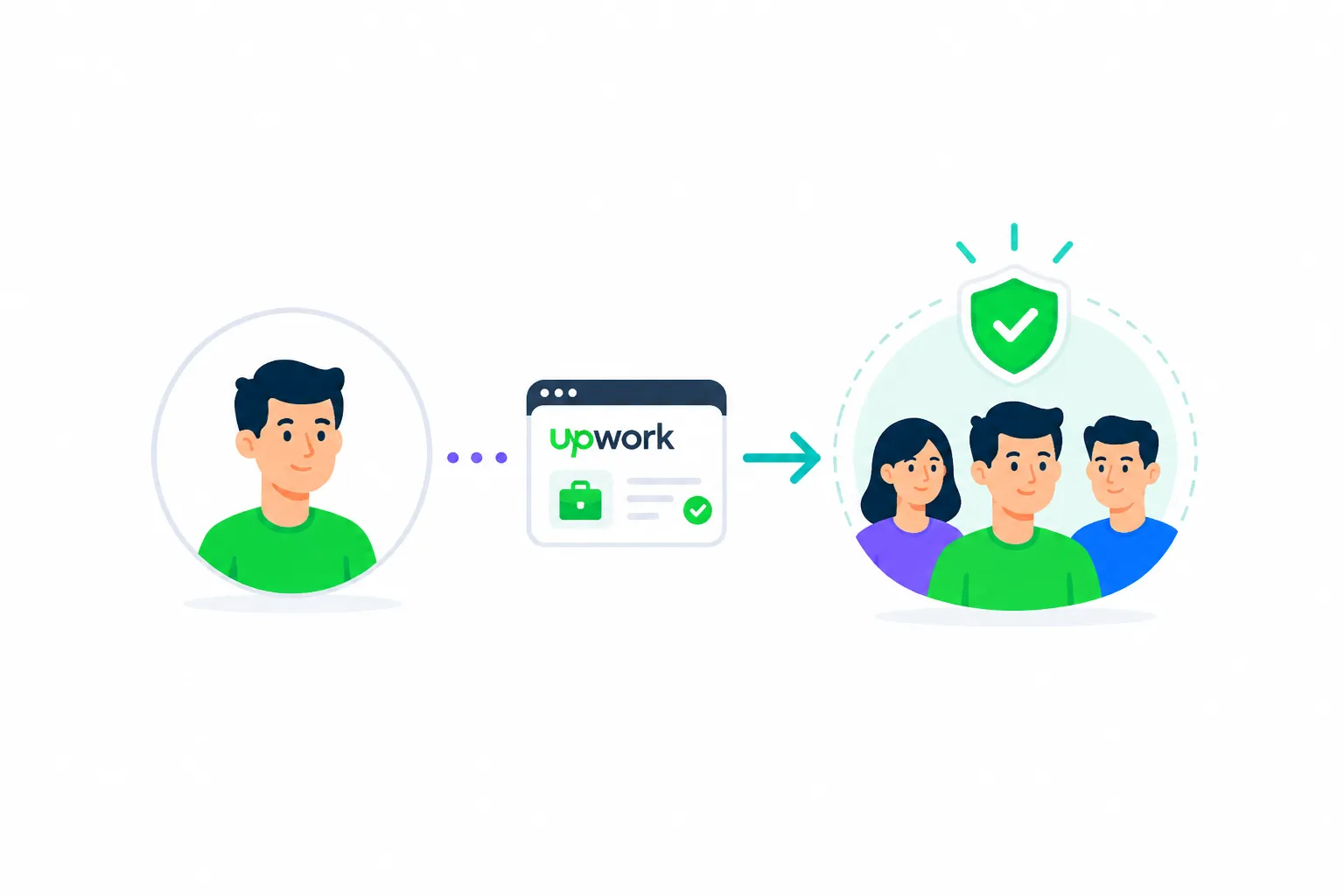
Going from solo freelancer to Upwork agency sounds exciting until the workload starts breaking your current system.
You are no longer just finding jobs for yourself. You are finding the right jobs, qualifying them faster, deciding which team member fits, writing proposals that still sound personal, protecting your Connects, and making sure you do not apply late to the best opportunities. If you try to scale with the same manual workflow you used as a solo freelancer, the agency will feel busy before it becomes profitable.
The real shift is not “hire people and take bigger projects.”
The real shift is building a repeatable machine for finding, filtering, pitching, and delivering better work. You need less randomness, fewer weak-fit proposals, clearer positioning, and a system that helps you move fast without sounding generic.
In this guide, you will learn how to transition from solo freelancer to Upwork agency in a practical way: when to make the move, what systems to build first, how to avoid messy growth, and how tools like GigUp can help you handle job discovery, matching, and proposal drafting with more control.
#The Hard Part About Becoming an Upwork Agency
The hard part is not getting more work.
The hard part is getting more of the right work without lowering your standards.
As a solo freelancer, you can rely on instinct. You know which jobs feel worth applying to. You know which clients sound risky. You know when a project fits your skills and when it will become a support nightmare.
But once you start operating like an agency, instinct is not enough.
You now need a process other people can follow.
That means you need answers to questions like:
- Which jobs should we apply to?
- Which jobs should we ignore?
- Who should handle each type of project?
- What does a strong proposal look like for our agency?
- How do we avoid wasting Connects on weak listings?
- How do we respond quickly without sounding like every other agency?
This is where many freelancers make the transition too early. They hire help before they have a clear acquisition system. Then every day becomes reactive.
One person is checking jobs manually. Another is rewriting proposals. Someone else is trying to manage delivery. Nobody knows which opportunities are actually worth chasing.
That is not an agency.
That is a solo freelancer with more stress.
#Why the Solo Workflow Breaks When You Scale
A solo workflow usually works because it lives inside your head.
You might have a rough process like this:
- Search Upwork manually.
- Open interesting jobs.
- Read the description.
- Decide if it feels worth it.
- Write a proposal.
- Hope the client replies.
That can work when you are applying to a small number of jobs yourself.
But it starts falling apart when you are trying to grow.
#You Miss Good Jobs Because You Are Late
Strong Upwork opportunities do not stay quiet for long. Good clients often receive proposals quickly, especially in competitive categories like development, design, writing, automation, and marketing.
If you only check Upwork when you have time, you are already behind.
The problem gets worse when you are managing a team. You may see a good job, but then you need to decide who fits, write the proposal, review it, and submit it. By the time you are ready, the client may already be talking to someone else.
Speed matters.
But speed without filtering creates waste.
#You Waste Connects on Jobs That Look Good but Are Not
Some job posts look attractive at first glance.
Good budget. Nice title. Clear category.
Then you read deeper and notice problems.
The client wants senior-level work for junior pay. The scope is vague. The timeline is unrealistic. The history looks weak. The project does not match your team’s real strengths.
As a solo freelancer, you may catch these details yourself.
As an agency, you need a system that catches them consistently.
Otherwise, your team burns Connects and time on jobs that were never likely to convert.
#Your Proposals Become Generic
This is one of the biggest agency traps.
A solo freelancer can sound personal because the proposal is written from direct experience. An agency often starts sounding like this:
We are a team of experienced professionals with expertise in modern technologies. We can complete your project with high quality and timely delivery.
That kind of proposal is safe, but it is forgettable.
Clients do not hire agencies because they use bigger words. They hire agencies when the agency clearly understands the problem, proves relevant experience, and gives the client confidence that delivery will be easier.
Scaling should not make your proposals colder.
It should make your proposal process sharper.
#Do Not Start an Agency Just Because You Are Busy
Being busy is not always a sign that you are ready to become an agency.
Sometimes it means your pricing is too low. Sometimes it means your scope control is weak. Sometimes it means you are accepting too many small jobs that do not compound into better positioning.
Before you move from solo freelancer to Upwork agency, ask a better question:
Do I have repeatable demand for a clear type of work?
That is the foundation.
If every project you take is different, every proposal is custom, every delivery process is new, and every client needs a different explanation, scaling will be painful.
But if you are repeatedly winning the same type of project, you have something to build around.
For example:
- Shopify speed optimization for ecommerce stores
- Laravel SaaS dashboards for founders
- API integrations for B2B tools
- WordPress to custom SaaS migrations
- AI automation workflows for small teams
- Cloud migration for growing startups
A focused agency is easier to sell than a general agency.
Clients trust clarity.
#The Right Time to Transition From Solo Freelancer to Agency
You do not need to wait until everything is perfect.
But you should see a few signals before making the move.
| Signal | What It Means | Why It Matters |
|---|---|---|
| You win similar projects repeatedly | Your market has a pattern | You can build a focused offer |
| You turn away good-fit work | Demand is larger than your personal capacity | Extra help may increase revenue |
| You have clear delivery steps | Work can be delegated | Quality is easier to protect |
| Your proposals follow a repeatable structure | Sales is becoming systemized | Others can help without hurting quality |
| You know which jobs to avoid | Your filtering is mature | You waste fewer Connects and less time |
| Clients ask for work outside your solo capacity | Bigger projects are available | An agency model may fit better |
The best time to transition is when you are not guessing anymore.
You know who you help. You know what problems you solve. You know which jobs are worth applying to. You know what a good client looks like.
Then the agency becomes an extension of your judgment, not a replacement for it.
#Build the Agency Around a Clear Position
A weak agency says:
We do web development, mobile apps, AI, automation, design, SEO, and anything else you need.
A stronger agency says:
We help SaaS teams build reliable Laravel and Vue dashboards, API integrations, and internal tools without slow communication or messy handoffs.
The second version is easier to trust.
Why?
Because it gives the client a shape.
They can quickly understand what you do, who you serve, and why your team might fit their project.
Your agency position should answer four simple questions:
- Who do you help?
- What expensive problem do you solve?
- What type of projects do you want more of?
- Why should a client trust your team instead of a random freelancer?
This does not mean you can never take other projects. It means your main profile, job filters, portfolio, and proposals should point in one clear direction.
If you are still deciding where to focus, this guide on the best Upwork niches for software developers in 2026 can help you think through positioning before you scale.
#Separate Your Agency Into Roles Early
Even a small agency needs role clarity.
You do not need a large team. You just need to stop treating every task like it belongs to you.
At minimum, think in these roles:
#1. Opportunity Finder
This role watches for good jobs, filters weak listings, and shortlists opportunities.
The mistake is treating this like simple admin work. It is not. Good job filtering directly affects revenue.
A poor opportunity finder sends bad jobs into the pipeline. Then the proposal writer wastes time. The team burns Connects. The agency gets fewer replies. Everyone thinks the problem is proposal quality, but the real problem started earlier.
#2. Proposal Owner
This role turns a qualified job into a strong response.
They do not just “write a cover letter.” They connect the job requirements to your agency’s proof, process, and relevant experience.
The proposal owner must understand your positioning. Otherwise, every proposal becomes a generic agency pitch.
#3. Delivery Lead
This role protects execution.
They translate client requirements into tasks, assign work, check quality, and keep communication clear.
This matters because selling more work without delivery control damages your agency fast. Upwork clients remember missed deadlines, unclear updates, and messy handoffs.
#4. Client Communicator
In the beginning, this may still be you.
That is fine.
But over time, client communication needs structure too. Updates, questions, scope changes, and handoffs should not depend on your mood or memory.
A good agency feels calm to the client.
That calm comes from systems.
#Create a Job Filtering System Before You Hire More People
Most freelancers think the first agency system should be delivery.
Delivery matters, of course.
But on Upwork, your job filtering system is just as important because it controls what enters the business.
Bad inputs create bad outcomes.
Imagine your team applies to 40 jobs this week. Half are weak fit. Ten have bad budgets. Five are vague and risky. Several already have too many proposals. Now your team is busy, but the pipeline is low quality.
Better filtering would have saved time before it was wasted.
#Use a Simple Job Scorecard
Before applying, score each job quickly.
| Filter Question | Good Sign | Bad Sign |
|---|---|---|
| Skill fit | Matches your core offer | Requires skills outside your team |
| Budget fit | Budget supports quality work | Unrealistic budget for scope |
| Client clarity | Problem is explained clearly | Vague “need expert” description |
| Urgency | Real business need | Random idea with no direction |
| Proof opportunity | You have relevant examples | No clear way to show credibility |
| Delivery risk | Scope can be controlled | Open-ended work with no boundaries |
You do not need a complex system.
You need a consistent one.
A simple rule helps: do not write a proposal until the job passes the filter.
This protects your Connects, your time, and your agency focus.
#Use Different Profiles for Different Agency Strengths
As a solo freelancer, one profile may be enough.
As an agency, you may need clearer separation.
For example, one agency might have different strengths:
- API integrations
- SaaS dashboard development
- WordPress maintenance
- AI workflow automation
- Cloud migration
- Technical consulting
If all of that gets pushed into one generic profile, the client may not see the exact fit.
This is where profile management matters.
Your agency should have a clear main position, but you can still organize different service angles. Each angle should have its own proof, keywords, examples, and proposal approach.
That is also why GigUp supports multiple profiles on Pro and Agency plans. You can create different profiles for different types of work, attach them to specific job trackers, and generate proposals that pull from the right experience instead of mixing everything into one broad pitch.
That matters when your agency is no longer selling one person.
You are selling the right match.
#Build a Proposal System That Still Sounds Human
Agency proposals often fail because they try too hard to sound impressive.
Clients are not looking for the longest proposal. They are looking for signs that you understand the job.
A strong agency proposal usually does four things:
- Opens with the client’s real problem.
- Shows relevant proof.
- Explains the next step clearly.
- Reduces perceived risk.
Bad proposal:
We are a professional agency with many years of experience. We can do your project perfectly. Please check our profile.
Better proposal:
You are not just looking for a Laravel developer here. You need someone who can clean up the dashboard flow without breaking the billing logic or slowing down the current users. We have handled similar SaaS admin panels where the main risk was not building new screens, but changing the system safely while users were active.
See the difference?
The better version is not louder. It is more specific.
Specificity builds trust.
#A Simple Agency Proposal Structure
Use this structure as a starting point:
- Problem recognition: Show you understand what the client is trying to solve.
- Relevant proof: Mention a similar project, result, or technical pattern.
- Approach: Explain how you would handle the work.
- Risk control: Address timeline, communication, testing, or scope.
- Next step: Ask a useful question or suggest a short call.
The goal is not to automate your voice away.
The goal is to remove the blank page so your team can respond faster with better thinking.
GigUp helps here by generating AI proposals based on the job post and your profile. You can then refine the draft with commands like “make it more conversational,” “focus on our React experience,” or “shorten it by 30%.” That keeps the process fast without turning every proposal into a copy-paste template.
#Move From Manual Hunting to Tracker-Based Discovery
Manual hunting works until it becomes the bottleneck.
An agency needs a more reliable way to discover opportunities.
That is where job trackers become useful.
Instead of manually searching Upwork again and again, you create saved searches for your core service areas. For example:
- “Laravel SaaS dashboard”
- “React frontend developer”
- “API integration”
- “WordPress maintenance”
- “cloud migration”
- “automation consultant”
Then each tracker becomes a focused opportunity stream.
The important part is not just tracking keywords. It is tracking the right market segment with the right criteria.
For example, a weak tracker says:
Show me all web development jobs.
A better tracker says:
Show me SaaS dashboard and Laravel/Vue jobs with serious client intent, clear scope, and budget that supports senior development.
That is a much better input.
GigUp lets you create custom Upwork job trackers, attach a profile, set match thresholds, and customize the AI prompt that evaluates jobs. This is useful when your agency has different service lines and you do not want every job mixed into one noisy feed.
#Set Match Thresholds So Your Team Does Not Chase Everything
One of the biggest problems in agency growth is opportunity greed.
You start thinking:
Maybe we should apply to this too.
That thinking gets expensive.
Every weak proposal costs time. Every weak job costs attention. Every bad client can pull your team away from better work.
A match threshold gives your team a clear line.
For example:
- 80–100%: Strong fit, apply fast
- 60–79%: Good fit, review manually
- 30–59%: Maybe, only if there is a strategic reason
- Below 30%: Skip
This is not about letting software make every decision.
It is about reducing noise so your team can make better decisions faster.
When GigUp scores jobs as Excellent, Good, Fair, or Poor, it gives you a practical starting point. You still decide. But you are no longer starting from a messy feed of random listings.
That is the difference between hunting and operating.
#Protect Your Delivery Before You Scale Sales
More proposals can create more replies.
More replies can create more calls.
More calls can create more projects.
That sounds good until delivery starts slipping.
Before you increase sales volume, create basic delivery standards.
You need simple answers for:
- How do we start a project?
- How do we collect requirements?
- How do we confirm scope?
- How do we update the client?
- How do we handle changes?
- How do we test work before delivery?
- How do we close a project cleanly?
You do not need a 50-page operations manual.
Start with checklists.
#Basic Agency Delivery Checklist
Before accepting a project:
- The scope is clear enough to estimate.
- The client’s goal is understood.
- The budget matches the work.
- The timeline is realistic.
- The responsible team member is assigned.
- The first milestone is clearly defined.
- Communication expectations are agreed.
- Risks are written down early.
During delivery:
- Send updates before the client asks.
- Keep all important decisions documented.
- Confirm changes before doing extra work.
- Test before sending work for review.
- Keep the client focused on agreed outcomes.
After delivery:
- Ask for feedback.
- Document what went well.
- Save reusable notes for future proposals.
- Turn strong results into portfolio proof.
This is how your agency gets stronger over time.
Every project should improve the system.
#Know What to Delegate and What to Keep
At the start, do not delegate everything.
Some tasks are safe to delegate early. Others need your judgment until the system is mature.
#Delegate Earlier
You can usually delegate:
- Initial job collection
- Basic job scorecard review
- First proposal drafts
- Portfolio formatting
- Project task breakdowns
- QA checklists
- Status update drafts
#Keep Longer
You should personally control:
- Final positioning decisions
- High-value proposal review
- Pricing strategy
- Risky client calls
- Major scope decisions
- Hiring decisions
- Quality standards
This balance matters.
If you keep everything, you do not build an agency.
If you delegate judgment too early, quality drops.
The goal is to slowly turn your judgment into rules, examples, templates, and review systems.
#Avoid the “More People, Same Chaos” Trap
Hiring does not fix a broken workflow.
It usually exposes it.
If your job filtering is messy, hiring an assistant will produce more messy shortlists.
If your proposals are generic, hiring a writer will produce more generic proposals.
If your delivery is unclear, hiring developers will create more confusion.
People multiply the system you already have.
So before adding more people, improve the system.
Ask:
- Do we know our best-fit project types?
- Do we have job filters?
- Do we have proposal examples?
- Do we know our minimum acceptable budget?
- Do we have a delivery checklist?
- Do we know what jobs to reject?
- Do we track which proposals get replies?
If the answer is no, fix that first.
#Track the Numbers That Actually Matter
You do not need complicated analytics.
But you do need basic visibility.
Track these numbers every week:
| Metric | Why It Matters |
|---|---|
| Jobs reviewed | Shows how much opportunity entered the pipeline |
| Jobs shortlisted | Shows filtering quality |
| Proposals sent | Shows sales activity |
| Proposal reply rate | Shows message quality and fit |
| Interviews booked | Shows client interest |
| Projects won | Shows conversion |
| Connects spent per win | Shows efficiency |
| Average project value | Shows whether the agency is moving upmarket |
The key metric is not “how many proposals did we send?”
The better question is:
How many good-fit opportunities did we apply to, and how many turned into serious conversations?
That tells you whether your agency is improving or just getting busier.
#A Practical 30-Day Transition Plan
Here is a simple way to start moving from solo freelancer to agency without creating chaos.
#Week 1: Define the Offer
Choose one main agency direction.
Write down:
- Your best-fit client type
- Your strongest service category
- Your minimum project size
- Your top proof points
- Jobs you will no longer chase
Do not skip this. A vague agency is hard to sell.
#Week 2: Build the Job Filter
Create your job scorecard.
Decide what makes a job Excellent, Good, Fair, or Poor for your agency.
Create saved Upwork searches around your main service lines. If you use GigUp, turn those searches into trackers and set match thresholds so the best jobs are easier to notice quickly.
#Week 3: Create Proposal Assets
Build a small proposal library.
Include:
- Strong opening examples
- Relevant case study snippets
- Common technical explanations
- Risk-reversal lines
- Discovery questions
- Short and long proposal versions
The goal is not to copy-paste.
The goal is to give yourself and your team better building blocks.
#Week 4: Delegate One Part of the Workflow
Do not hire a full team immediately.
Delegate one controlled task first.
For example:
- Have someone shortlist jobs using your scorecard.
- Have someone prepare first proposal drafts.
- Have someone organize portfolio examples.
- Have someone manage project QA checklists.
Then review the output and improve the system.
Scale one layer at a time.
#What Bad Agency Growth Looks Like
Bad growth feels exciting for a few weeks.
Then it gets heavy.
You apply to more jobs, but replies do not improve. You hire help, but quality becomes inconsistent. You win projects, but delivery gets stressful. You start accepting weak-fit clients because the team needs work.
That is not growth.
That is pressure.
Bad agency growth usually has these symptoms:
- Too many service categories
- No clear job filtering process
- Generic proposals
- Weak client qualification
- No delivery checklist
- No proposal performance tracking
- Too much work dependent on the founder
- Too many low-margin projects
The fix is not to work harder.
The fix is to narrow the system.
#What Better Agency Growth Looks Like
Better growth feels calmer.
You know what jobs you want. You reject weak opportunities faster. Your proposals are more relevant. Your team understands the agency’s positioning. Your delivery process is simple but consistent.
You are not trying to win every project.
You are trying to win the right projects repeatedly.
That is the mindset shift.
A strong Upwork agency is not just a group of freelancers under one name. It is a focused system for turning the right opportunities into strong client outcomes.
#Where GigUp Fits Into the Transition
GigUp is useful when the bottleneck is no longer your skill, but your workflow.
As you move from solo freelancer to agency, you need faster discovery, smarter filtering, and proposal drafts that are based on the right profile and project context.
GigUp helps with that by letting you:
- Create Upwork job trackers for your service areas
- Score jobs against your profiles with AI matching
- Set relevance thresholds so weak jobs do not flood your attention
- Get alerts through email, Telegram, or Slack depending on your plan
- Generate tailored proposals from your profile and the job post
- Manage multiple profiles for different service lines or team strengths
This does not replace your judgment.
It gives your judgment a system.
And that is exactly what you need when you are moving from solo work to agency work.
#FAQ
#Should I create an Upwork agency if I am already getting too much work?
Maybe, but do not assume busyness means you are ready. First check whether the demand is repeatable, profitable, and focused. If you are only overloaded because you accept too many small or messy jobs, fix positioning and pricing before building an agency.
#Can I run an Upwork agency with only one or two helpers?
Yes. An agency does not need to be large. Even one assistant, developer, designer, or project coordinator can help if the workflow is clear. Start small and delegate one part of the process at a time.
#Should my agency apply to more jobs than I did as a solo freelancer?
Not always. The better goal is to apply to better-fit jobs with stronger proposals. More proposals only help if your filtering and message quality stay high.
#How do I stop agency proposals from sounding generic?
Use specific job context, relevant proof, and a clear approach. Avoid broad claims like “we are experts.” Show that you understand the client’s actual problem and explain how your team would reduce risk.
#What should I systemize first?
Start with job filtering and proposal quality. Those two systems control the quality of your pipeline. If weak jobs enter the pipeline, everything after that becomes harder.
#Final Thought
The transition from solo freelancer to Upwork agency is not about looking bigger.
It is about becoming more consistent.
You need a clearer offer, better filters, faster job discovery, stronger proposal assets, and a delivery process that does not depend on memory. When those pieces are in place, hiring help becomes safer because people are joining a system instead of guessing what is inside your head.
Start with focus.
Then build the workflow.
And when manual job hunting starts slowing you down, use GigUp to turn your Upwork search, matching, alerts, and proposal drafting into a more reliable agency pipeline.