
White labeling can look like easy money until the workflow gets messy.
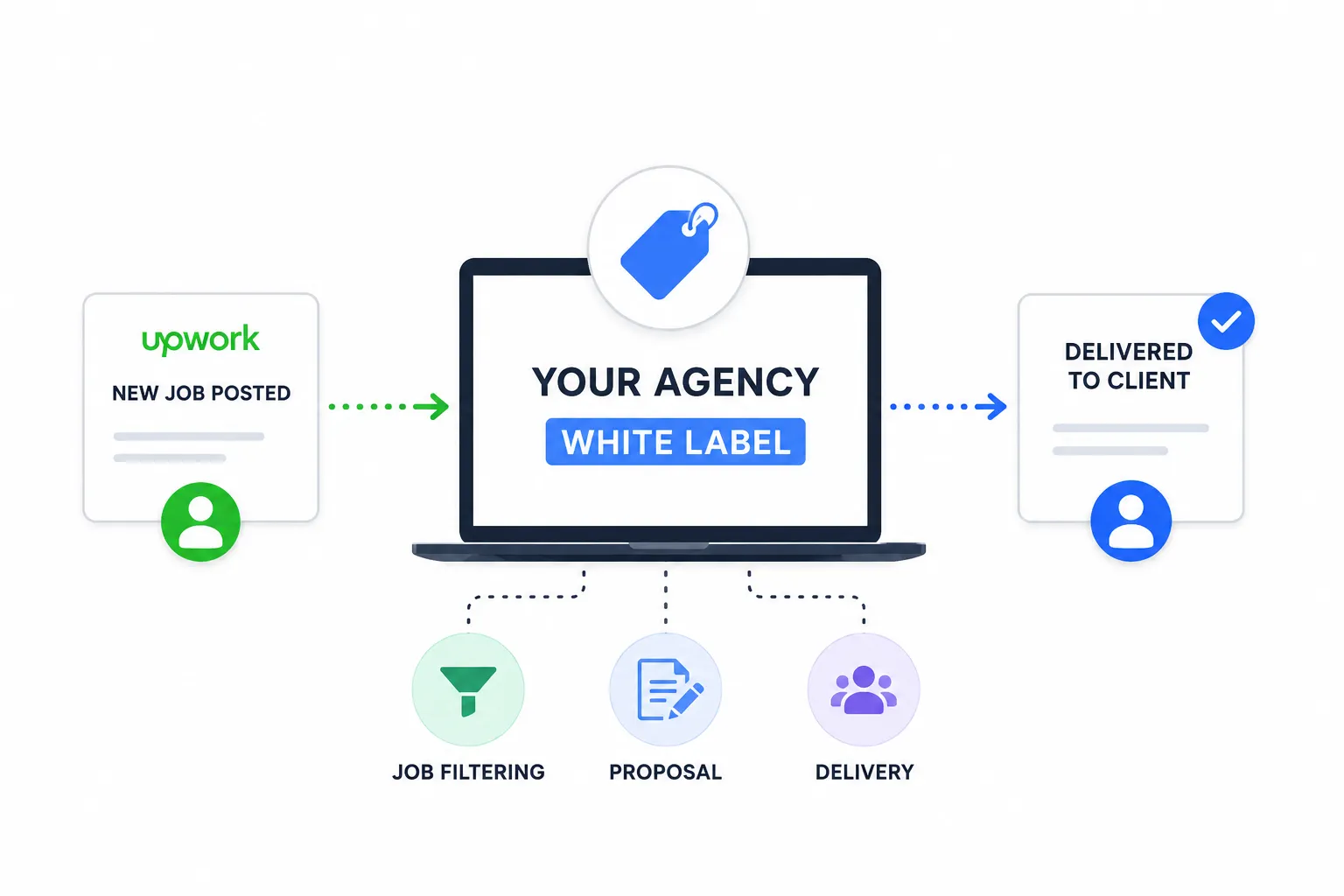
You win a project on Upwork, another freelancer or small team does the delivery behind the scenes, and the client sees your agency as the main provider. That can work well. But if you handle it badly, it can damage your reputation, create client confusion, hurt delivery quality, and turn one good contract into a stressful chain of revisions, delays, and awkward explanations.
The core idea is simple: white labeling is not about pretending you personally do everything. It is about owning the client relationship, managing the delivery system, and making sure the final work meets the standard you promised.
In this guide, you will learn how white labeling works for agencies on Upwork, when it makes sense, what can go wrong, and how to build a practical workflow for finding better projects, filtering weak-fit jobs, drafting stronger proposals, and delivering client work without losing control.
#What White Labeling Means on Upwork
White labeling means your agency sells a service under your own brand, while another person, contractor, or internal team helps deliver some or all of the work.
For example:
You run an Upwork agency that sells Shopify development.
A client hires your agency.
Behind the scenes, one developer handles theme work, another handles app integrations, and you manage communication, quality, scope, and final delivery.
To the client, the experience is still with your agency.
That is the important part.
White labeling is not just outsourcing. Outsourcing is handing work to someone else. White labeling means you package, manage, review, and deliver the work as part of your agency’s own service standard.
The client is not buying random labor.
They are buying your process.
#Why Agencies Use White Labeling
White labeling becomes useful when your agency starts getting more opportunities than one person can handle.
At the solo stage, you can survive by doing everything yourself. You hunt for jobs, write proposals, take calls, do the work, manage revisions, and send updates. But that model breaks when you want to scale.
Sooner or later, one of these things happens:
- You find good jobs but cannot apply fast enough
- You win projects but do not have enough delivery time
- You want to offer more services than your personal skill set allows
- You want recurring client work without being stuck in every small task
- You need specialists for design, development, copy, QA, or support
White labeling helps because it separates the agency owner role from the delivery role.
You are no longer only “the person doing the work.”
You become the person building the system that wins, manages, and delivers the work.
That shift matters.
#The Real Risk: Selling Before You Have a Delivery System
The biggest mistake agencies make is using white labeling as a shortcut.
They win a project first, then rush to find someone who can do it later.
That is dangerous.
Imagine you apply to a high-value Upwork project for a SaaS dashboard. The client replies quickly. The budget is good. The scope includes Laravel, Vue, billing, analytics, and admin roles. You say yes because the job looks profitable.
Then you start looking for developers after the contract begins.
Now you are under pressure. You are hiring fast, not carefully. You are explaining unclear requirements to someone who was not part of the client conversation. The freelancer asks questions you should have answered before accepting the job. The client expects progress, but you are still building the delivery team.
That is not white labeling.
That is panic management.
Good white labeling starts before the sale.
You need a clear service menu, a vetted delivery bench, internal quality standards, communication rules, and a strong job filtering process.
#White Labeling Works Best When the Offer Is Clear
A white label agency should not chase every project.
This is where many Upwork agencies lose money. They think scaling means saying yes to more work. In reality, scaling means saying yes to more of the right work.
If your agency sells “anything related to websites,” your delivery system will always feel chaotic.
One project is WordPress speed optimization.
The next is a custom SaaS dashboard.
The next is Shopify design.
The next is API troubleshooting.
The next is Webflow migration.
Every project needs different talent, different pricing, different timelines, and different review standards. That makes white labeling harder than it needs to be.
A better agency offer is narrow enough to repeat.
For example:
- Shopify store setup for small e-commerce brands
- Laravel SaaS MVP development for founders
- WordPress to custom SaaS migration planning
- API integration projects for B2B software teams
- Ongoing maintenance retainers for funded startups
- Landing page design and development for agencies
The more repeatable the offer, the easier it is to white label.
Repeatable offers create repeatable delivery.
#The Simple White Label Agency Model
Think of white labeling as a three-layer system.
#1. The Client Layer
This is what the client sees.
They see your Upwork profile, your proposal, your agency brand, your call, your project plan, your communication, and your final delivery.
This layer must feel clean and professional.
The client should never feel like the project is being thrown around between disconnected freelancers.
#2. The Management Layer
This is where you control the work.
You define scope, assign tasks, check quality, manage deadlines, handle client updates, and make sure the work matches what was sold.
This is the layer most new agencies underestimate.
The client does not care how many people helped.
They care whether the final outcome is useful, on time, and aligned with what they asked for.
#3. The Delivery Layer
This is where your team, contractors, or specialist partners do the work.
They might write code, design screens, test features, fix bugs, draft copy, or prepare assets.
Your job is not to disappear from the process.
Your job is to make sure the delivery layer works quietly and reliably behind the client experience.
#Bad White Labeling vs Better White Labeling
Here is the difference in practical terms:
| Area | Bad White Labeling | Better White Labeling |
|---|---|---|
| Job selection | Applies to anything with a decent budget | Filters jobs by service fit, budget, timeline, and team capacity |
| Client communication | Promises fast delivery before checking resources | Sets clear scope, timeline, milestones, and review process |
| Contractor selection | Finds someone after winning the job | Has vetted specialists ready before applying |
| Quality control | Sends work directly from contractor to client | Reviews and improves work before client sees it |
| Proposal writing | Sounds broad and generic | Connects client problem to a clear agency process |
| Delivery | Reactive and stressful | Structured with roles, checkpoints, and internal standards |
| Profit | Shrinks because of revisions and delays | Protected through better pricing and scope control |
The difference is not talent.
It is process.
#How to Choose Which Upwork Jobs Are Safe to White Label
Not every Upwork job is a good white label opportunity.
Some jobs look profitable but create hidden risk. The client may be vague, rushed, technical, under-budgeted, or hard to satisfy. If you are adding a delivery layer behind the scenes, those risks become more expensive.
Before applying, ask a few simple questions.
#Is the scope clear enough to delegate?
If the job post is only two lines long and the client wants “a full platform like Airbnb,” be careful.
White labeling works better when the outcome is clear enough to explain to another person.
A vague job can still be good, but only if your proposal turns it into a discovery call or paid planning phase.
#Does the budget support both delivery and management?
If you win a $500 project and pay a contractor $400, you are not running an agency. You are buying yourself stress for $100.
White labeling only works when the budget covers:
- The person doing the work
- Your management time
- Revisions
- Client communication
- Quality control
- Profit
- Risk
If the margin is too thin, one extra revision can erase the whole project.
#Can your agency add real value?
If your only value is “I found someone cheaper,” the model is weak.
Your agency should add value through better scoping, clearer communication, stronger process, faster execution, quality review, or specialized judgment.
That is what clients pay for.
#Does the job match your current delivery bench?
Do not apply first and hope you can find someone later.
If you have strong Laravel developers, chase Laravel work.
If your team is good at Shopify, chase Shopify.
If your contractors are strong at API integrations, focus there.
This is also why smart job discovery matters. You do not just need more Upwork jobs. You need the right jobs early enough to apply with confidence.
#A Practical Checklist Before You Apply
Use this before sending a proposal for any white label-friendly Upwork job.
| Question | Why It Matters |
|---|---|
| Do we already have someone who can deliver this? | Prevents panic hiring after winning |
| Is the scope clear enough to estimate? | Protects margin and timeline |
| Can we explain our process simply? | Makes the proposal stronger |
| Is the client’s budget realistic? | Avoids low-profit delivery traps |
| Can we produce proof or relevant examples? | Builds trust faster |
| Is the timeline reasonable? | Keeps delivery quality under control |
| Do we know the review/checkpoint process? | Reduces revision chaos |
| Would we want more clients like this? | Helps build a repeatable agency niche |
If you cannot answer most of these, slow down.
A bad project can cost more than no project.
#How to Write Upwork Proposals for White Label Agency Work
Your proposal should not say, “We can do everything.”
That sounds weak.
Clients on Upwork are already surrounded by broad, generic proposals. If you want to win better agency projects, your proposal needs to show control.
A strong white label agency proposal does three things:
- It proves you understood the client’s problem
- It explains your delivery process clearly
- It reduces the client’s risk
Here is the mental model:
Do not sell “a team.”
Sell “a managed outcome.”
A client does not wake up excited to manage your developers. They want the project handled. So your proposal should make the client feel like you have already thought through the messy parts.
#Bad Proposal Framing
“We are an agency with expert developers and designers. We can complete this project quickly. Let’s discuss.”
This says almost nothing.
It could apply to any job.
#Better Proposal Framing
“Your main risk here is not just building the dashboard. It is making sure the user roles, billing logic, and admin workflows are defined before development starts. I would handle this in three steps: first map the core flows, then build the dashboard in milestones, then test the user permissions before handoff.”
This feels specific.
It shows judgment.
It gives the client a reason to trust your process.
If you want a deeper breakdown on writing proposals that lead to better replies, this guide on building a smarter Upwork bidding strategy is a useful next read.
#Where GigUp Fits Into a White Label Agency Workflow
White labeling only works when your front-end sales process is sharp.
You cannot afford to waste time manually refreshing Upwork, reading weak-fit listings, and writing proposals for jobs that your agency should not even take.
That is where GigUp fits naturally.
GigUp helps agencies create Upwork job trackers, score new jobs against their profiles, and generate tailored proposal drafts faster. Instead of manually hunting through the feed, you can set trackers for the exact service categories your agency can deliver.
For example, you might create separate trackers for:
- Laravel SaaS builds
- Shopify maintenance contracts
- API integration work
- WordPress to custom platform migrations
- Long-term agency support projects
Then GigUp can help evaluate each new job against your agency profile, your preferred budget range, your skills, and your custom matching criteria.
That matters because white label agencies need speed and fit.
A strong job posted 20 minutes ago is different from a strong job posted 12 hours ago with 50 proposals. Timing affects visibility. Fit affects win rate. Proposal quality affects whether the client replies.
GigUp helps with all three.
#How to Build a Simple White Label Workflow
You do not need a complicated agency machine to start.
You need a workflow that prevents chaos.
Here is a practical version.
#Step 1: Define Your Core Service
Pick one main service category your agency can deliver reliably.
Not ten.
One.
For example: “API integrations for SaaS companies” is better than “web development.”
A focused service makes job filtering, pricing, proposals, contractor selection, and case studies much easier.
#Step 2: Build a Small Delivery Bench
You do not need a huge team.
Start with two or three reliable people who can handle the work you sell.
For each person, know:
- What they are good at
- What they should not touch
- Their availability
- Their price range
- Their communication style
- Their turnaround time
- Their quality level without heavy supervision
Do not wait until you win a job to learn these things.
#Step 3: Create Job Trackers Around Your Offer
Your Upwork job search should match your delivery strength.
If your agency is good at API integrations, do not waste your best hours reading logo design jobs, low-budget WordPress fixes, or vague startup ideas.
Use saved searches and job trackers around your actual service categories.
With GigUp, this becomes easier because you can monitor specific Upwork search URLs and use AI matching to score whether a job is worth your attention.
#Step 4: Use a Qualification Filter Before Applying
Before writing a proposal, check:
- Is this project within our service focus?
- Is the budget healthy enough?
- Is the client serious?
- Is the timeline realistic?
- Do we have proof or relevant experience?
- Can our team deliver without heroic effort?
This one step saves Connects, time, and reputation.
#Step 5: Draft Proposals Around Process, Not Headcount
Do not lead with “we have a team.”
Lead with the problem, the plan, and the outcome.
Clients care less about how many people are involved and more about whether someone competent is managing the project.
Your proposal should make the client think:
“This agency understands the risk and has a clear way to handle it.”
#Step 6: Keep Delivery Internally Visible
Use a simple project board, checklist, or shared workspace.
Track:
- Client requirements
- Milestones
- Assigned work
- Internal deadlines
- Review notes
- Client feedback
- Final deliverables
White labeling gets risky when the agency owner loses visibility.
You should always know what is happening before the client asks.
#Step 7: Review Before Anything Reaches the Client
This is non-negotiable.
Do not let contractors send work directly to the client without your review unless there is a very clear reason.
You own the client relationship.
That means you own the final quality.
#How to Price White Label Work on Upwork
Pricing is where many agencies quietly fail.
They price like freelancers but operate like agencies.
That does not work.
As an agency, your price must cover more than the direct work. It must include management, planning, revision handling, communication, QA, contractor margin, and risk.
A simple pricing rule:
If you cannot pay the delivery person fairly and still keep enough margin to manage the project properly, the job is probably not worth taking.
For fixed-price projects, build in room for:
- Discovery or planning
- Internal review
- Client revisions
- Unexpected clarification
- QA
- Final handoff
For hourly projects, be clear about who is doing what and how work is tracked.
Do not hide complexity from yourself just to make the price feel easier to sell.
That is how agencies win work and lose money.
#How to Handle Client Trust Without Creating Confusion
One sensitive part of white labeling is transparency.
You do not need to over-explain your internal staffing model in every proposal, but you should not mislead the client either.
A healthy way to frame it:
“I’ll be your main point of contact and will manage the delivery. Depending on the project needs, I may involve trusted specialists from my team for specific parts of the work.”
That is simple.
It tells the truth.
It also reassures the client that someone is accountable.
The danger is pretending you personally do every task when you do not. That creates trust issues later if the client notices different communication styles, inconsistent work, or delays caused by people they did not know existed.
Better to position yourself as the project lead from the beginning.
#Common White Labeling Mistakes to Avoid
White labeling is powerful, but it punishes weak systems.
Watch for these mistakes.
#Taking Projects Outside Your Delivery Strength
A project can be profitable on paper and still be a bad fit.
If your agency does not have the skill, proof, or process to deliver it well, skip it.
#Selling Too Cheap
Low pricing creates pressure.
Pressure leads to rushed hiring, rushed delivery, and weak review.
White labeling needs margin.
#Letting Contractors Control Client Experience
Your team can help deliver the work.
They should not define the client experience unless you fully trust them and the process is clear.
#Applying Too Late
Good Upwork jobs move fast.
If you find the right job too late, your proposal has to fight through a crowded field. That is why agencies need faster discovery and smarter filtering, not just better writing.
#Using Generic Proposals
Agency proposals must feel specific.
The client should see that you understand the project, not just that you have people available.
#When White Labeling Is Not a Good Fit
White labeling is not always the answer.
Avoid it when:
- The client expects direct access to one specific expert
- The work requires your personal style or judgment throughout
- The scope is unclear and the budget is weak
- You do not have a trusted delivery person available
- The deadline is too tight for review
- The project has high risk and low margin
- You are only taking it because you feel desperate
Sometimes the best agency decision is to not apply.
That is not lost revenue.
That is protected focus.
#A Better Way to Think About Scaling an Upwork Agency
Scaling is not about winning more random jobs.
It is about building a machine that repeatedly wins the right jobs and delivers them without breaking trust.
That machine has a few parts:
- Clear positioning
- Fast job discovery
- Strong qualification filters
- Better proposal drafting
- Reliable delivery partners
- Quality control
- Consistent communication
- Healthy margins
White labeling fits inside that machine.
It is not the machine by itself.
If your agency uses white labeling without good job selection, you will scale stress. If you combine white labeling with smarter filtering, stronger proposals, and a repeatable delivery process, you can scale capacity without lowering quality.
That is the real goal.
#FAQ
#Is white labeling allowed on Upwork?
White labeling can work as an agency model when you manage the client relationship honestly and follow Upwork’s rules. The key is not to misrepresent who is doing the work or create a misleading client experience. If you are operating as an agency, make sure your structure, communication, and delivery process are clear and professional.
#Should I tell the client I use other people for delivery?
You should not pretend everything is done personally by you if that is not true. A simple and professional approach is to say that you will be the main point of contact and may involve trusted team members or specialists when needed. This builds trust without overcomplicating the conversation.
#What type of Upwork jobs are best for white labeling?
The best jobs are clear, repeatable, properly budgeted, and aligned with your team’s strengths. Maintenance contracts, development retainers, API integrations, Shopify work, WordPress projects, QA, design production, and technical implementation work can all fit if you have the right process.
#What is the biggest risk of white labeling?
The biggest risk is losing control of quality and communication. If your delivery person misses details, replies poorly, or sends unfinished work, the client blames your agency. That is why internal review and project management matter so much.
#Can a solo freelancer start white labeling?
Yes, but start small. Do not sell a full agency service before you have trusted help. Begin by involving one specialist for a narrow part of the work, such as design, QA, or implementation support. Build confidence before expanding.
#How can GigUp help with white label agency work?
GigUp helps you find better-fit Upwork jobs faster, score them against your agency profile, and generate more relevant proposal drafts. That helps white label agencies avoid weak-fit listings, apply earlier to strong opportunities, and keep the proposal process more consistent.
#Final Thought
White labeling can help you grow from solo freelancer to real Upwork agency, but only if you treat it like a system.
The goal is not to hide people behind your brand.
The goal is to build a reliable client experience where your agency owns the outcome, manages the process, and delivers work at a standard clients can trust.
Start with a narrow offer. Build a small delivery bench. Filter jobs carefully. Write proposals around process. Review work before the client sees it.
And if the manual Upwork hunt is slowing you down, GigUp can help you find the right jobs earlier, filter them with AI, and draft stronger proposals before better opportunities disappear into a crowded feed.