
How to Write an Upwork Follow Up Message After Sending a Proposal Without Sounding Pushy
You send a proposal, spend Connects, wait, and hear nothing. That silence is expensive. Not just because you paid to apply, but because every dead proposal steals time, attention, and momentum from the jobs you actually could have won.
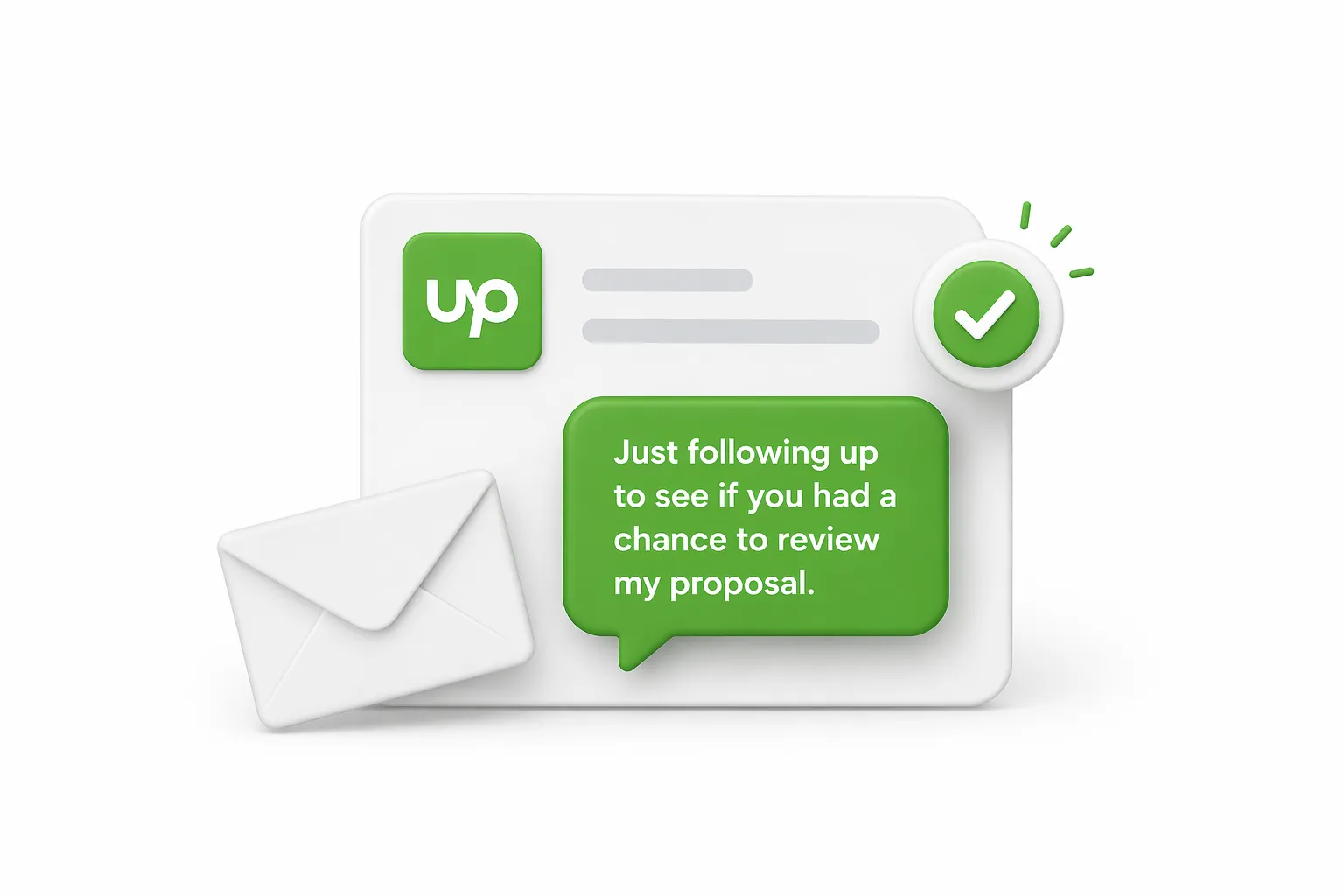
The mistake most freelancers make is thinking the follow-up is about “checking in.” It is not. A good Upwork follow up message is a small sales asset. Its job is to reopen attention, reduce client friction, and make it easier for the client to reply.
This article will show you how to write an Upwork follow up message after sending a proposal in a way that feels human, sharp, and useful. You will learn when to follow up, what to say, what to avoid, and how to build a workflow that gives your best proposals a real second chance.
#The Real Problem With Following Up on Upwork
Most follow-ups fail for one simple reason: they add no value.
They sound like this:
Just following up on my proposal. Please let me know if you are interested.
That message is polite. It is also weak.
It gives the client no new reason to respond. No clarity. No confidence. No momentum. It basically says, “I am still here,” which is not the same as saying, “I can help you solve this faster and with less risk.”
That is the real problem. A bad follow-up feels like pressure. A good follow-up feels like progress.
Imagine two freelancers applying to the same job.
The first sends a decent proposal and then follows up with a generic reminder.
The second sends a proposal, waits, then follows up with a short message that clarifies the project, shows they understood the client’s goal, and offers a clean next step.
Same job. Same platform. Very different signal.
#Why It Matters More Than People Think
A lot of freelancers treat follow-ups like a tiny detail. They are not.
When clients post on Upwork, they are often dealing with three things at once: too many applicants, not enough time, and incomplete thinking about what they actually need. Your follow-up can help on all three.
Here is what is really happening behind the screen:
- Some clients are interested but distracted
- Some opened your proposal and forgot to respond
- Some are comparing three decent candidates and need one more reason to choose
- Some are unsure whether you understood the project well enough
A follow-up will not rescue a weak proposal. But it can absolutely improve the odds of a strong one getting attention.
That is why speed and relevance matter so much on Upwork. If you want more visibility before the job gets crowded, read /blog/best-times-to-bid-upwork-2026. If you want the first message itself to do more heavy lifting, /blog/upwork-proposal-strategy-2026 is the right companion piece.
#What a Good Upwork Follow Up Message Actually Does
A good follow-up does four things:
#1. It reminds the client who you are
Clients forget fast. Your message should bring them back to your angle in one sentence.
Not your life story. Not your full background. Just the relevant hook.
#2. It reduces uncertainty
Hiring feels risky. Your follow-up should lower that risk a little.
You do that by sounding clear, specific, and calm. Not needy. Not vague. Not over-eager.
#3. It adds one useful thing
This is where most freelancers miss.
A strong follow-up usually includes one extra insight, idea, question, or micro-recommendation. Something that proves you are thinking about the work, not just chasing the reply.
#4. It makes the next step easy
Clients reply when the path is simple.
If your message ends with an easy decision such as “I can outline the first 3 fixes I would make” or “I can share a simple rollout plan,” you make it easier to say yes.
#When You Should Follow Up and When You Should Not
Timing matters, but context matters more.
Here is a practical decision table:
| Situation | Should you follow up? | Best angle |
|---|---|---|
| You sent a strong, tailored proposal and got no reply | Yes | Add one useful insight and a simple next step |
| The client viewed your proposal or engaged before going quiet | Yes | Re-anchor around the project goal |
| Your original proposal was generic or rushed | Usually no | Fix your process first |
| The client already rejected you clearly | No | Move on |
| The job post looks messy, suspicious, or low-intent | Usually no | Protect time and Connects |
| The job is still active and highly relevant to you | Yes | Keep it short, calm, and helpful |
A good rule: follow up only when the opportunity is still worth winning.
If the client already looks chaotic, controlling, or vague, the follow-up may just pull you deeper into a bad fit. That is where judgment matters more than persistence.
#The Mental Model: Your Follow-Up Is a Tiny Project Update
This framing helps.
Do not think of the follow-up as a reminder. Think of it as a tiny project update sent before the project starts.
That means your message should sound like someone who already understands the work, not someone asking for attention.
Bad follow-up energy:
- “Did you see my proposal?”
- “Any update?”
- “Please respond”
Better follow-up energy:
- “I looked at the problem again and here is the fastest way I would approach it.”
- “One thing I noticed from your brief is where the bottleneck probably is.”
- “If helpful, I can send a short breakdown of the first steps.”
See the difference?
One is asking for validation. The other is offering forward motion.
#How to Write an Upwork Follow Up Message After Sending a Proposal
Keep it simple. Most good follow-ups follow this structure.
#Start with context
Remind them which project you are referring to and what you solve.
Example:
Hi, circling back on your Shopify conversion tracking setup project. I took another look at the brief and I think the biggest issue is probably not the tags themselves, but the event mapping between checkout and ads.
That already sounds more useful than “Just following up.”
#Add one real observation
Give the client something concrete.
This could be:
- a likely mistake in their setup
- a smarter first step
- a small tradeoff they may not be considering
- a question that shows deeper understanding
Example:
If your reporting is inconsistent, I would check whether the purchase event is firing correctly across both browser and server-side tracking before changing campaign logic.
Now you are not just a freelancer. You are a calm operator.
#Make the next step feel easy
Do not force a call. Do not overcomplicate it.
Offer one light next step.
Example:
If you want, I can send a short 3-step plan for how I would audit and fix it before we start.
That is easy to answer.
#End without pressure
A good ending feels open, not clingy.
Example:
Happy to share that here if the project is still open.
Simple. Clean. No begging.
#A Plug-and-Play Formula You Can Reuse
Use this formula:
Context + useful insight + low-friction next step
Here is the template:
Hi [Client Name], following up on your [project type] post. I took another look at the brief, and one thing that stood out is [specific observation]. In similar projects, I have found that [short practical point]. If helpful, I can send a quick outline of how I would approach the first step. Happy to share it here if the project is still active.
That is the core structure.
Now let us make it sharper.
#5 Examples of Strong Upwork Follow Up Messages
#Example 1: For a web development project
Hi, following up on your Laravel dashboard project. I took another look at the scope, and it seems the bigger risk is not the dashboard UI itself but how roles, permissions, and reporting logic are structured underneath. If helpful, I can send a quick breakdown of the backend structure I would suggest before development starts.
#Example 2: For a design project
Hi, circling back on your landing page redesign. One thing I noticed is that the brief focuses a lot on visuals, but the real conversion lift will probably come from improving hierarchy, CTA placement, and mobile clarity. If the project is still open, I can share the first 3 layout changes I would test.
#Example 3: For a content writing project
Hi, following up on your SaaS blog writing role. I had another look at the brief, and it seems like you need someone who can do more than fill words. The bigger win is turning product knowledge into articles that actually help qualified readers move closer to action. If helpful, I can show how I would structure one post from intro to CTA.
#Example 4: For a marketing project
Hi, checking back on your Meta ads audit project. Based on the brief, my guess is the issue is probably in conversion signal quality and offer-message fit more than campaign setup alone. If the role is still active, I can send a short audit framework I would use to diagnose it.
#Example 5: For a general client reply nudge
Hi, following up on the proposal I sent for your project. I took another look at your requirements and had one idea that could save time in the first phase: start with a smaller scoped milestone to validate the approach before building everything out. If useful, I can outline what that first milestone should include.
#What to Avoid in Your Follow-Up
This part matters just as much as the writing.
#Do not ask if they “saw” your proposal
It sounds passive and awkward.
Clients know they got proposals. The better question is whether you can help them move.
#Do not send long essays
A follow-up is not a second proposal.
If it takes too long to read, it creates work. Your job is to reduce work.
#Do not sound emotionally invested too early
Avoid lines like:
- “I really need this opportunity”
- “I would love to work with you please reply”
- “I am the perfect fit”
That energy lowers trust.
#Do not follow up without a reason
A message with no new value just creates noise.
#Do not keep chasing dead leads
One smart follow-up is strategic. Repeated chasing is usually wasted motion.
#A Simple Checklist Before You Send the Follow-Up
Use this quick filter:
| Question | Yes / No |
|---|---|
| Was my original proposal actually tailored to this job? | |
| Is this still a good-fit client and project? | |
| Does my follow-up add one useful idea, question, or recommendation? | |
| Is the message short enough to read fast? | |
| Does it end with an easy next step? | |
| Would this message make sense even if I desperately wanted the job? |
If you cannot answer yes to most of these, do not send it yet.
Fix the message first.
#The Better Workflow: Proposal First, Follow-Up Second, System Always
Here is where most freelancers lose money: they focus too much on writing better follow-ups and not enough on building a better pipeline.
The follow-up only matters if the right jobs are reaching you early, your proposal is relevant, and your message stays consistent.
That is where tools start to matter.
GigUp makes sense in this workflow because it solves the parts that usually break before the follow-up stage even begins:
- finding strong-fit jobs earlier
- scoring jobs against your profile
- helping you avoid weak-fit listings
- generating sharper proposal drafts that are easier to build on later
That means your follow-up is no longer a desperate rescue attempt. It becomes a clean second touch on a job that already made sense to pursue.
Before: you manually scroll, apply late, send a rushed proposal, then wonder if a follow-up can save it.
After: you catch better jobs faster, apply with more relevance, and only follow up where the math actually makes sense.
That is a much better business.
#A Practical Follow-Up Process You Can Use This Week
#Step 1: Only shortlist proposals worth following up on
Do not follow up on everything.
Choose jobs where:
- the fit is strong
- the budget and scope make sense
- your proposal was customized
- the client looks real and reasonably serious
#Step 2: Wait long enough to avoid looking jumpy
You want to look attentive, not twitchy.
The exact timing can vary, but the principle is simple: give the client breathing room, then send one thoughtful nudge while the project still feels live.
#Step 3: Write one message with one purpose
Pick one angle only:
- clarify the problem
- reduce risk
- suggest a smart first step
- offer a light deliverable
Trying to do all of them in one short message makes it bloated.
#Step 4: Track what gets replies
This is where you stop guessing.
Notice which follow-up styles work best for:
- technical projects
- design jobs
- long-term client relationships
- fast-turnaround gigs
Patterns show up faster than people think when you actually track them.
#Step 5: Move on fast when there is no signal
This is important.
A follow-up should improve your odds, not hijack your week. If there is no response, keep your pipeline moving.
#FAQ
#Should I always send an Upwork follow up message after sending a proposal?
No. Only do it when the project is still worth winning and your original proposal was strong enough to deserve a second touch.
#How long should an Upwork follow up message be?
Short. Usually a few sentences is enough. The goal is to reopen attention, not re-pitch the whole job.
#What should I say in a follow-up if I have no new information?
Usually nothing. If you have no added value, the message will probably feel generic. Wait until you can offer a useful angle or skip the follow-up.
#Can a follow-up improve my chances on Upwork?
Yes, but mostly when the initial proposal was relevant and the follow-up reduces friction for the client. It will not fix a weak application to a bad-fit job.
#Should I ask for a call in the follow-up?
Only if it feels natural and low-pressure. Often it is better to offer a simple written next step first.
#Final Take
The best Upwork follow up message after sending a proposal is not a reminder. It is a useful, low-pressure nudge that shows you understand the work and makes it easier for the client to move forward.
That is the standard.
Keep it short. Make it relevant. Add one real thought. End with an easy next step.
And more importantly, do not build your whole Upwork strategy around rescuing weak proposals after the fact. Build a workflow that gets you into better jobs earlier, with stronger fit and cleaner messaging from the start.
That is exactly where GigUp helps. When better job discovery, smarter filtering, and more relevant proposal drafting are already built into your process, the follow-up stops being a gamble and starts becoming a smart edge.