

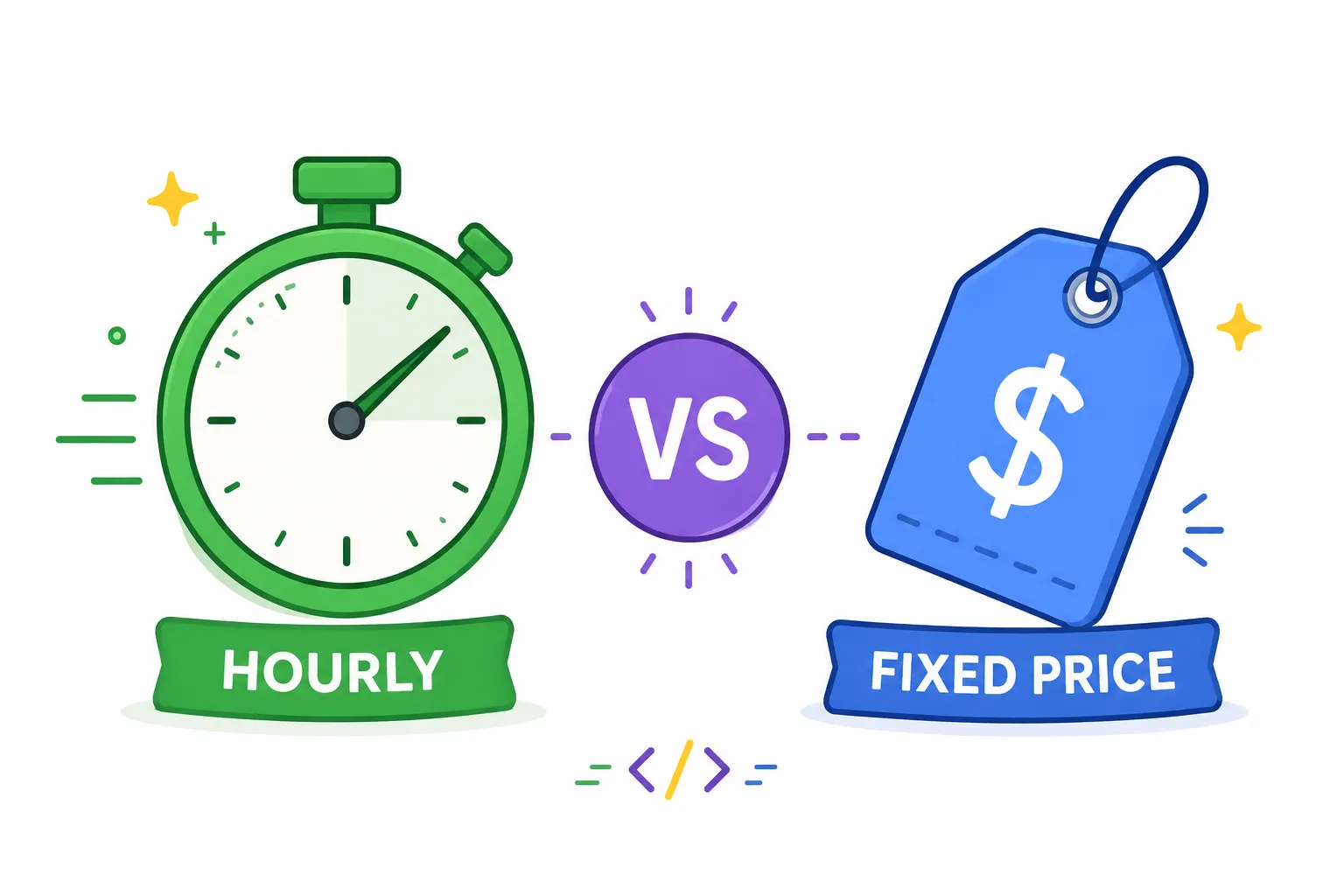
Hourly vs Fixed Price on Upwork for Freelance Developers: How to Choose the Right Contract Type
Freelance developers lose money on Upwork for a boring reason: they choose the wrong contract structure before the real work even starts.
A fixed-price project can look clean until the client keeps adding “one small thing.” An hourly project can feel safer until the client expects speed, constant screenshots, and weekly progress without clear priorities. The mistake is not choosing hourly or fixed price. The mistake is choosing without understanding the risk behind the job.
The better question is simple: what kind of uncertainty are you being paid to handle?
If the scope is clear, fixed price can work beautifully. If the scope is messy, technical, exploratory, or likely to change, hourly often protects you better. This guide will help you decide which model fits different development projects, how to protect your time, and how to filter Upwork jobs before wasting Connects on work that was risky from the start.
#The Real Problem Is Not Hourly vs Fixed Price
Most freelancers frame this as a pricing debate.
Hourly means you get paid for time.
Fixed price means you get paid for the result.
That is true, but too basic.
The real difference is who carries the uncertainty.
With hourly work, the client carries more uncertainty because the final cost can change as the project evolves. With fixed price, you carry more uncertainty because you agree to deliver a result for a set amount, even if the work becomes more complex than expected.
For developers, that difference matters a lot.
A logo design, landing page copy, or simple data entry task may be easy to define upfront. But software work is full of hidden traps:
- The API documentation is outdated.
- The existing codebase is messy.
- The client forgot about edge cases.
- The plugin conflicts with another plugin.
- The staging server is different from production.
- The “small bug” is actually an architecture problem.
That is why freelance developers need a sharper rule.
Do not choose a contract type based on what the client posted.
Choose based on how much you can clearly understand before starting.
#Why This Decision Affects Your Income
Bad contract structure quietly damages your Upwork business.
You may still get paid, but you lose time, energy, and proposal quality. One bad fixed-price job can eat three days you planned to spend on better opportunities. One poorly managed hourly job can turn into endless calls, vague tasks, and low-trust tracking.
Here is the hidden cost.
When you choose the wrong model, you do not just lose money on that contract. You also lose timing on better jobs. You miss strong listings. You send rushed proposals. You burn Connects on weak-fit projects because your attention is stuck inside a messy contract.
That is why this topic connects directly to bidding strategy.
A strong developer on Upwork is not only good at coding. They are good at spotting which projects deserve attention, which ones need clarification, and which ones should be skipped before the first proposal.
#How Hourly and Fixed-Price Contracts Work on Upwork
Upwork supports both hourly and fixed-price contracts. Upwork describes hourly contracts as work billed through logged time, while fixed-price contracts are based on defined milestones with funds deposited before work begins. ([Upwork Support][1])
That simple difference creates very different behavior.
#Hourly Contracts
Hourly contracts are best when the work is ongoing, unclear, investigative, or likely to change.
Think of tasks like:
- Debugging a production issue
- Refactoring an old codebase
- Maintaining a SaaS app
- Building features in weekly sprints
- Reviewing architecture
- Handling API issues where the cause is unknown
- Working with a startup that changes priorities often
The client is buying your time and judgment.
That does not mean hourly work should be vague. You still need clear goals. But you are not pretending every unknown can be priced perfectly upfront.
Upwork’s Hourly Payment Protection has specific requirements, including logging time with the Upwork Desktop App, adding relevant memos or activity labels, staying within the weekly limit, and working with a client who has a verified billing method. Manual time and bonuses are not covered the same way. ([Upwork Support][2])
So hourly can be safer, but only if you work cleanly.
Use the tracker. Add memos. Keep activity tied to the contract. Do not rely on casual trust when payment protection depends on process.
#Fixed-Price Contracts
Fixed-price contracts are best when the deliverable is specific, contained, and easy to verify.
Think of tasks like:
- Build one landing page from a Figma file
- Create a WordPress plugin with clear requirements
- Fix three listed bugs
- Integrate one payment gateway
- Convert a design into responsive HTML/CSS
- Build a small MVP feature with defined acceptance criteria
The client is buying an outcome.
That can be great when the scope is tight. You can price based on value, work efficiently, and avoid the feeling of selling hours.
But fixed price becomes dangerous when the client only describes the dream, not the deliverable.
Bad fixed-price post:
Need a full SaaS platform like Trello with AI features. Budget $300.
Better fixed-price post:
Need a Laravel developer to add Stripe subscription checkout to an existing app. User roles and pricing plans already exist. Deliverable: checkout page, webhook handling, subscription status update, and basic test flow.
The second one is still not perfect, but it gives you something to estimate.
Upwork’s fixed-price protection is tied to funded milestones. The client deposits funds before work begins, and the freelancer submits work for approval. Upwork says funds may be released automatically after 14 days if the client does not approve the work or request changes. ([Upwork Support][3])
That means your protection starts with clean milestones.
A vague milestone is not protection. It is just a future argument.
#A Simple Mental Model for Developers
Use this rule:
Hourly is for uncertainty. Fixed price is for clarity.
That one sentence solves most of the confusion.
If the job requires discovery, debugging, research, communication, testing, or iteration, hourly is usually better.
If the job has a clear input, clear output, clear limit, and clear definition of done, fixed price can work well.
Here is the practical breakdown.
| Project Situation | Better Contract Type | Why |
|---|---|---|
| Existing app has unknown bugs | Hourly | You do not know the root cause yet |
| Client wants ongoing feature work | Hourly | Priorities may change weekly |
| Client has a clear Figma design and page list | Fixed price | Scope can be estimated |
| API integration with unclear docs | Hourly or paid discovery first | Hidden complexity is likely |
| Small, listed bug fixes | Fixed price | Deliverables can be counted |
| Long-term SaaS maintenance | Hourly | Work will be recurring and variable |
| MVP with vague requirements | Hourly or phased fixed price | Full scope is not known yet |
| WordPress customization with clear tasks | Fixed price | Outcome is defined |
| Performance optimization | Hourly | Results depend on diagnosis and constraints |
| Technical architecture planning | Fixed price for audit, hourly for implementation | Strategy can be packaged, build work may change |
This is not about which model is “better.”
It is about which model matches the shape of the work.
#When Freelance Developers Should Choose Hourly
Hourly is strongest when the client needs your thinking, not just your output.
A lot of development work looks simple from the outside. “Fix login issue” sounds small. But the real problem could be session handling, database migration, OAuth config, browser storage, middleware order, or broken deployment settings.
You cannot price that responsibly without seeing the system.
#Choose hourly when the job has unknowns
Hourly is usually better when the job includes phrases like:
- “Need someone to investigate”
- “Not sure what is wrong”
- “Existing developer disappeared”
- “Fix bugs in our current app”
- “Improve performance”
- “Help us finish”
- “Ongoing support”
- “Need a senior developer to advise”
- “Scope may grow”
These are not automatically bad jobs.
Some of them are excellent.
But they are poor candidates for fixed-price unless you first sell a paid discovery milestone.
#Choose hourly when the client wants ongoing work
If the client says they need help every week, do not force it into a fixed-price package.
Hourly fits better because the work will change.
One week may be bug fixes. The next may be an API integration. The next may be database cleanup. A fixed price will either become too vague or too restrictive.
For ongoing work, you can still create structure:
- Set a weekly hour limit.
- Agree on priorities at the start of each week.
- Send short progress updates.
- Log clean memos.
- Keep commits and task notes organized.
Hourly does not mean unstructured.
It means flexible with accountability.
#Choose hourly when the client is technical enough to collaborate
Hourly works best when the client understands that development involves tradeoffs.
They do not need to be an engineer. But they should respect process.
A good hourly client says:
“Let’s start with 5–10 hours to investigate and estimate the next steps.”
A risky hourly client says:
“This should only take one hour. I know it is simple.”
That second sentence is usually not about budget. It is about control.
#When Freelance Developers Should Choose Fixed Price
Fixed price is strongest when the job has a clear finish line.
This is where many developers can increase profit. If you are fast, experienced, and confident in the scope, fixed price lets you charge for value instead of time.
But only when the scope is real.
#Choose fixed price when the deliverable is specific
Good fixed-price work has boundaries.
Example:
“Build a responsive pricing page from this Figma design. Include desktop and mobile layouts. Use existing Tailwind components. No backend work.”
That is clear.
You know the input. You know the output. You know what is not included.
Bad fixed-price work sounds like this:
“Build a modern website for my startup. Must be clean, fast, SEO-friendly, and professional.”
That may become anything.
Five pages? Twenty pages? Copywriting? CMS? Blog? Animations? Forms? Integrations? Hosting? Revisions?
You cannot price a fog.
#Choose fixed price when acceptance criteria are clear
Before taking a fixed-price contract, ask yourself:
- What exactly will I deliver?
- How will the client approve it?
- What counts as done?
- What is excluded?
- How many revisions are included?
- What assets must the client provide?
- What happens if the client changes direction?
If you cannot answer those, the job is not ready for fixed price.
#Choose fixed price when you can split the project into milestones
One large fixed-price milestone is risky.
Smaller milestones are cleaner.
Instead of:
Build full SaaS app — $3,000
Use:
Milestone 1: Technical planning and database structure — $400 Milestone 2: Auth, roles, and dashboard shell — $700 Milestone 3: Core feature workflow — $1,000 Milestone 4: Testing, fixes, and deployment support — $900
This protects both sides.
The client sees progress. You reduce the chance of doing weeks of work before payment. The project becomes easier to manage.
For more developer positioning, you can also read GigUp’s guide on choosing better software niches on Upwork: /blog/best-upwork-niches-for-software-developers-in-2026-where-to-focus-for-better-clients
#The Best Option: Paid Discovery Before Fixed Price
For developers, paid discovery is often the cleanest middle ground.
Use it when the client wants a fixed price, but the scope is not clear enough yet.
You can say:
“I can give you a fixed quote after reviewing the codebase and requirements. The safest first step is a small discovery milestone where I audit the current setup, identify risks, and outline the implementation plan.”
This is not a delay tactic.
It is professional risk control.
#What a discovery milestone can include
A strong discovery milestone might deliver:
- Codebase review
- Technical risk notes
- Feature breakdown
- Database or API review
- Estimated implementation phases
- Fixed-price quote for the next milestone
- Questions the client must answer before build starts
This does two things.
First, it protects you from guessing.
Second, it shows the client you think like a serious developer, not a desperate bidder.
#Bad vs Better Contract Decisions
Let’s make this concrete.
#Scenario 1: “Fix my broken checkout”
Bad response:
“I can do it fixed price for $100.”
Better response:
“Checkout issues can come from Stripe config, webhook handling, frontend validation, database state, or deployment settings. I’d suggest starting hourly for diagnosis, then I can give you a fixed quote once the cause is clear.”
Why better?
Because you are not pricing the unknown as if it were known.
#Scenario 2: “Build this landing page from Figma”
Bad response:
“Hourly is best because I do not know how long it will take.”
Better response:
“I can do this fixed price if the scope is limited to the provided Figma design, responsive implementation, and one revision round. Backend forms, copy changes, and extra sections would be separate.”
Why better?
Because the job is clear enough to package.
#Scenario 3: “Need ongoing React developer”
Bad response:
“I can create a fixed monthly package for unlimited tasks.”
Better response:
“Hourly would fit this better. We can set a weekly cap, agree on priorities each Monday, and review progress every Friday.”
Why better?
Because ongoing development is not a single deliverable.
#A Practical Decision Checklist
Use this before sending a proposal.
| Question | If Yes | If No |
|---|---|---|
| Can I define the exact deliverable? | Fixed price may work | Consider hourly or discovery |
| Is the codebase already built by someone else? | Hourly is safer | Fixed price may still work |
| Are requirements likely to change? | Hourly is safer | Fixed price may work |
| Can I list what is excluded? | Fixed price becomes safer | Scope is still too vague |
| Does the client want ongoing support? | Hourly usually fits | Fixed price may fit one task |
| Is the job mainly debugging? | Hourly or discovery | Fixed price if bug is isolated |
| Are milestones easy to define? | Fixed price can work | Avoid large fixed-price scope |
| Is the client pushing “quick and easy”? | Be careful | Evaluate normally |
Here is the simplest version:
- Use hourly when the work is uncertain.
- Use fixed price when the outcome is clear.
- Use paid discovery when the client wants fixed price but the scope is foggy.
- Skip the job when the client refuses clarity.
That last point matters.
Some clients do not want a better contract structure. They want someone to absorb their confusion for cheap.
Do not be that person.
#How to Explain Your Choice in a Proposal
The way you explain contract type can make or break the reply.
Do not sound defensive.
Do not lecture the client.
Frame it around project success.
#If you recommend hourly
Say something like:
“Because this involves an existing codebase and the root cause is not clear yet, hourly is the safer structure. I can start with a focused diagnosis, document what I find, and then we can decide whether the remaining work should stay hourly or move into a fixed milestone.”
This sounds calm and professional.
You are not asking for open-ended trust. You are giving the client a controlled first step.
#If you recommend fixed price
Say something like:
“This looks like a good fit for fixed price because the deliverable is clear. I’d structure it as one milestone for the page build, with responsive implementation and one revision round included. Any extra sections or backend changes can be scoped separately.”
This shows confidence.
It also protects you from scope creep without sounding difficult.
#If you recommend paid discovery
Say something like:
“I would not want to guess a full build quote before reviewing the current setup. A small discovery milestone would let me inspect the codebase, confirm the risks, and give you a cleaner implementation plan with a reliable quote.”
This positions you as careful, not expensive.
#How GigUp Helps You Spot Better Contract Opportunities
The hard part is not only choosing hourly or fixed price after a client replies.
The harder part is finding the right jobs early enough to make a smart proposal.
That is where a better workflow helps.
GigUp lets you create Upwork job trackers based on saved search URLs, then uses AI matching to score jobs against your profile. For developers, that means you can build separate trackers for different opportunity types:
- React hourly maintenance jobs
- Fixed-price WordPress builds
- Laravel SaaS projects
- API integration work
- Cloud migration projects
- Long-term full-stack roles
Then you can guide the AI with criteria that match your strategy.
For example:
“Prioritize hourly jobs involving existing SaaS apps, debugging, refactoring, or ongoing feature work. Avoid low-budget fixed-price MVPs with vague scope.”
Or:
“Prioritize fixed-price jobs with clear deliverables, Figma files, defined integrations, funded milestones, and realistic budgets.”
This matters because contract type is part of job quality.
A strong fixed-price listing with clear scope may be worth fast action. A vague fixed-price listing with a tiny budget may be a Connects trap. A messy hourly debugging job may be excellent if the client has a real budget and respects diagnosis.
GigUp helps you see that difference faster, before you spend your best energy writing proposals for the wrong work.
#A Simple Workflow for Developers
Here is a practical weekly process.
#Step 1: Separate your trackers by contract strategy
Do not track all developer jobs in one messy feed.
Create different buckets:
- Hourly debugging and maintenance
- Fixed-price landing pages or WordPress work
- SaaS feature development
- API integrations
- Technical audits and consulting
Each bucket should have different evaluation criteria.
A fixed-price landing page job and an hourly SaaS maintenance role should not be judged the same way.
#Step 2: Filter for scope clarity
Before applying, scan for signals.
Good signs:
- Specific tech stack
- Clear deliverables
- Existing assets
- Realistic budget
- Defined business goal
- Client explains current problem
- Client has relevant past hiring history
Risk signs:
- “Simple job” with unclear scope
- “Need clone of X”
- Very low budget for complex build
- No details about current system
- Wants fixed price for unknown debugging
- Pushes urgency but gives no context
You do not need perfect listings.
You need enough clarity to make a smart next move.
#Step 3: Match your proposal to the risk
Do not send the same proposal to every job.
For hourly uncertainty, sell controlled diagnosis.
For fixed-price clarity, sell a clean deliverable.
For vague but promising work, sell paid discovery.
That is how you sound like a developer who knows how projects actually succeed.
#Step 4: Protect the contract before starting
Before accepting, confirm:
- Contract type
- Milestone or weekly cap
- Deliverables
- Revision limits
- Access requirements
- Communication rhythm
- What is not included
- Payment method status where relevant
This may feel basic.
But basic protection saves real money.
#Common Mistakes Developers Make
#Mistake 1: Taking fixed price because the client prefers it
Client preference matters, but risk matters more.
If the client wants fixed price for an unknown codebase, do not blindly agree. Offer discovery first.
#Mistake 2: Using hourly as an excuse for weak scope
Hourly does not mean “we will figure everything out later.”
You still need priorities, updates, and boundaries.
#Mistake 3: Pricing fixed-price projects too close to estimated hours
If you estimate 10 hours and price exactly 10 hours, you have no room for communication, testing, revisions, or surprises.
Fixed price should include risk.
#Mistake 4: Ignoring red flags because the budget looks good
A high-budget vague job can still become painful.
Look for clarity, not just money.
#Mistake 5: Sending proposals before understanding the contract model
Your proposal should show that you understand how the work should be structured.
That alone can separate you from cheaper bidders.
#FAQ
#Is hourly better than fixed price on Upwork for developers?
Hourly is better when the work is uncertain, ongoing, or investigative. Fixed price is better when the deliverable is clear and easy to define. For developers, hourly often fits debugging, maintenance, refactoring, and long-term feature work. Fixed price works better for scoped builds, small integrations, and defined milestones.
#Should I accept fixed-price debugging jobs?
Be careful. Debugging often has unknown causes. If the issue is not clearly isolated, start with hourly diagnosis or a paid discovery milestone. After you understand the cause, you can quote a fixed price for the fix.
#Can fixed-price projects be profitable for developers?
Yes, if the scope is clear and you price for value, not just estimated hours. Fixed price rewards speed and expertise, but it punishes poor scoping. Use clear milestones, written exclusions, and acceptance criteria.
#What should I do when a client wants fixed price but the scope is vague?
Suggest a small paid discovery milestone. Explain that it helps you review the codebase, identify risks, and provide a reliable quote. Good clients usually respect this. Bad clients often reveal themselves here.
#How do I avoid scope creep on fixed-price projects?
Write down what is included, what is excluded, how many revisions are included, and what counts as done. Split larger work into milestones. Do not start extra work until the client agrees to a new milestone or contract adjustment.
#The Smarter Choice Is About Risk, Not Preference
Hourly and fixed price are both useful.
The mistake is treating them like personality types.
You are not an “hourly freelancer” or a “fixed-price freelancer.” You are a developer choosing the structure that fits the risk of the work in front of you.
Use hourly when the client needs your time and judgment through uncertainty.
Use fixed price when the client needs a clear deliverable with a clean finish line.
Use paid discovery when the project could be valuable, but the scope is not ready yet.
And before you spend Connects, check whether the listing deserves your attention at all. GigUp helps you find stronger Upwork opportunities faster, score them against your profile, and generate proposals that match the real shape of the job instead of treating every listing the same.
That is how you stop guessing.
And on Upwork, less guessing usually means better clients, cleaner contracts, and fewer painful surprises.